Author: Site Editor Publish Time: 12-03-2026 Origin: Site


When it comes to securing a commercial building, the lock you choose matters far more than most people realize. A substandard lock on a high-traffic door isn't just a security risk—it's a liability. That's why architects, contractors, and facility managers consistently turn to ANSI Grade 1 mortise locks for commercial applications.
The Keyman M700 Series is one of the most capable options in this category. UL listed for a 3-hour fire rating and fully compliant with ANSI/BHMA A156.13 Grade 1 specifications, it's engineered for demanding environments where performance and durability are non-negotiable. This guide breaks down what makes a mortise lock the right choice for commercial doors, explores the four variants in the M700 lineup, and explains how to choose the right one for your project.
A mortise lock is installed by cutting a pocket (or "mortise") directly into the door, housing the lock body within the door itself. This design makes it significantly stronger than a standard cylindrical lock, which sits on the surface of the door. The result is a more secure, more durable, and longer-lasting solution—especially on heavy commercial doors that see thousands of cycles per year.
ANSI (American National Standards Institute) grades locks from 1 to 3, with Grade 1 being the highest standard. To earn Grade 1 certification, a lock must pass rigorous testing including:
250,000 operating cycles without failure
Resistance to heavy physical force and tampering
Consistent latch and bolt performance under stress
For commercial buildings, schools, hospitals, and government facilities, Grade 1 is typically the minimum requirement—and often mandated by building codes.
The Keyman M700 Series goes beyond the baseline Grade 1 requirement. All bolts are crafted from stainless steel, and most working parts inside the lock case are made from high-strength steel alloy. This construction gives the M700 exceptional resistance to wear, corrosion, and forced entry.
The UL listing for a 3-hour fire rating is another critical distinction. In a fire emergency, a door lock needs to maintain its structural integrity long enough for occupants to evacuate and for fire barriers to function as designed. The M700's 3-hour fire rating means it meets the strict testing protocols required for fire-rated door assemblies—a key requirement for stairwells, corridors, and exit routes in commercial construction.

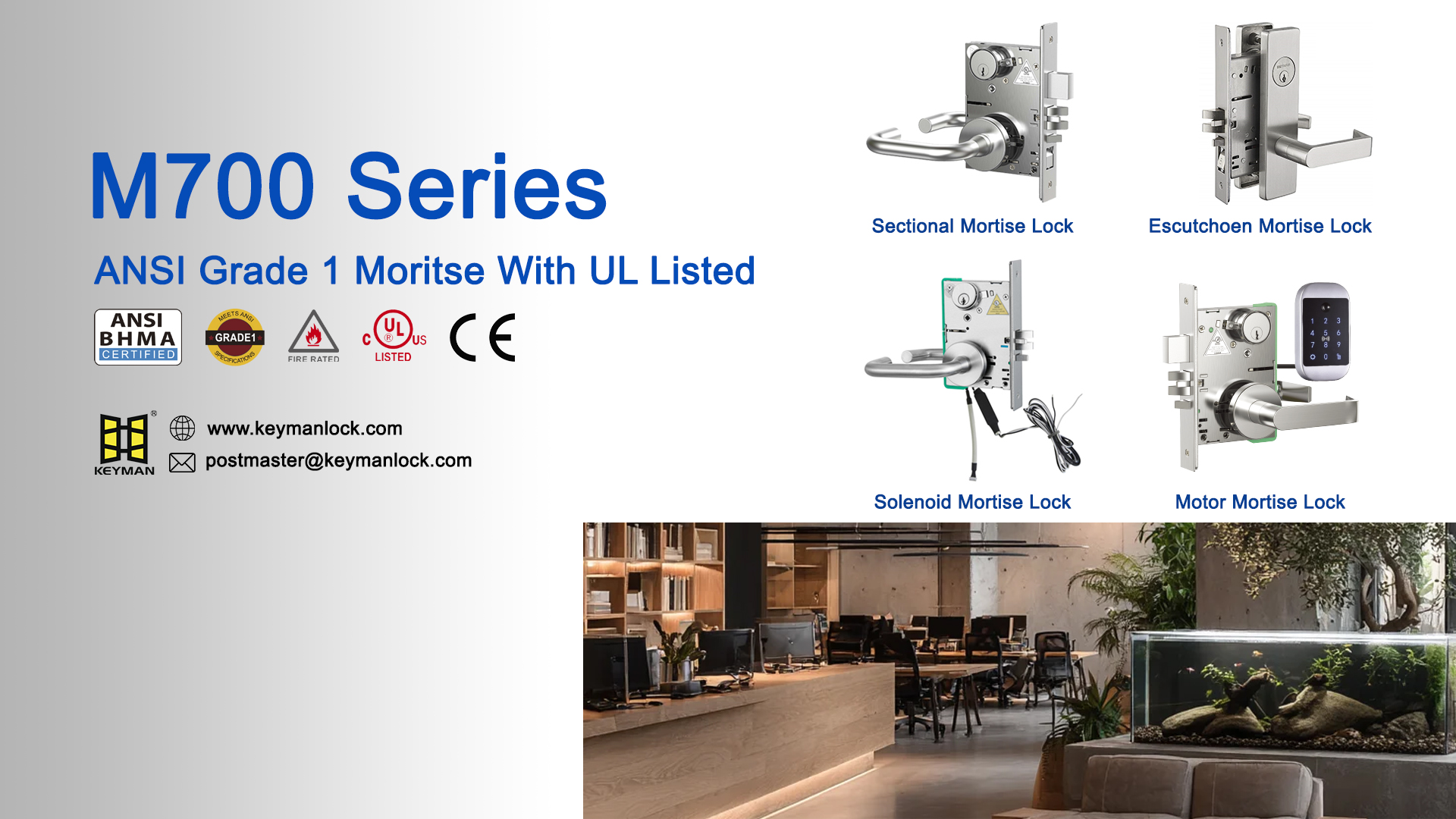
The M700 Series comes in four configurations, each designed to suit different installation requirements and access control needs.
The Sectional Mortise Lock is a mechanical solution built for straightforward, high-durability applications. Its sectional design makes installation and maintenance more efficient—components can be serviced or replaced without removing the entire lock body from the door.
This variant is ideal for high-cycle doors in commercial environments where reliability and ease of maintenance are top priorities. The sectional architecture also allows for greater flexibility when paired with a range of trim options.
The Escutcheon Mortise Lock is a mechanical mortise lock that integrates with a decorative escutcheon plate—the visible trim piece surrounding the keyhole and handle. This design provides a cleaner, more finished appearance while maintaining all the structural integrity of the M700 platform.
This option suits commercial projects where aesthetics matter alongside performance. Office lobbies, hotel corridors, and educational facilities are typical applications. The escutcheon design also simplifies cylinder replacement, making it a practical choice for buildings that require frequent re-keying.
The Solenoid Mortise Lock is a wired electrified solution that integrates the M700's mechanical strength with electronic access control. A solenoid is an electromagnetic device that controls the lock's latch or bolt via an electrical signal—allowing the lock to be controlled remotely, triggered by a card reader, keypad, or building management system.
This configuration is well-suited for access-controlled entry points where security teams need to manage who enters and exits in real time. Because the solenoid relies on a wired connection, it's typically specified for new construction or renovation projects where conduit can be run through the door frame.
Key advantages include:
Fail-safe or fail-secure operation depending on configuration
Compatibility with most access control platforms
Consistent performance in high-security applications
1
The Motor Mortise Lock is the wireless variant in the M700 lineup. Instead of a solenoid, it uses a small motor to drive the locking mechanism—and it communicates wirelessly with the broader access control system. This makes installation significantly easier in retrofit scenarios where running new wiring through existing walls and door frames isn't practical.
Motor mortise locks are increasingly common in smart building applications, where wireless communication protocols allow centralized management of dozens or hundreds of doors from a single platform. For facilities upgrading their access control infrastructure without a full renovation, this variant offers the most flexibility.
Regardless of which M700 variant you select, there are several installation considerations worth addressing early in the specification process.
Door Preparation: Mortise locks require precise door preparation. The mortise pocket must be cut to the correct depth and dimensions, and the door thickness must be compatible with the lock body. Always verify door thickness—typically 1¾" for commercial applications—against the lock manufacturer's specifications.
Handing: Mortise locks are typically handed, meaning they're configured for either a left-hand or right-hand door. Confirm door handing before ordering.
Strike Plate Alignment: The strike plate must be precisely aligned with the bolt and latch for the lock to operate correctly. Misalignment is one of the most common installation errors and can compromise both security and longevity.
Fire Door Compliance: For fire-rated applications, the complete door assembly—frame, door, hinges, lock, and closer—must meet fire rating requirements. Installing a UL listed lock like the M700 on a non-rated door does not create a compliant assembly.
The M700 Series is specified across a wide range of commercial and institutional projects, including:
Healthcare facilities: Hospitals and clinics require high-cycle locks that can withstand constant use and meet strict hygiene and fire safety standards.
Educational buildings: Schools and universities rely on Grade 1 hardware for classrooms, administrative offices, and exit corridors.
Government and municipal buildings: Security requirements in government facilities typically mandate Grade 1 hardware across all entry and exit points.
Commercial office buildings: High-rise office towers and corporate campuses specify mortise locks for their durability and compatibility with centralized access control.
Hospitality: Hotels benefit from the M700's combination of aesthetic trim options and electronic access control integration.
1
Specifying the right mortise lock comes down to three factors: performance requirements, access control needs, and installation constraints. The M700 Series addresses all three—offering a mechanical option for straightforward applications, an escutcheon variant for appearance-sensitive projects, and both wired and wireless electrified options for access-controlled environments.
All four variants share the same ANSI Grade 1 foundation: stainless steel bolts, high-strength alloy internals, and a 3-hour UL fire rating. That consistency makes the M700 a reliable choice across a full range of commercial applications.
To learn more about the M700 Series or to request a quote, visit keymanlock.com or contact the Keyman team directly.


