
Quick answer:
UL 305 and UL 10C are two distinct UL certifications for commercial door hardware. UL 305 governs panic and fire exit hardware, ensuring doors can be opened quickly during an emergency evacuation. UL 10C certifies that fire-rated door assemblies—including their hardware—can withstand fire exposure under positive pressure testing. Both are required for different compliance purposes, and confusing them can lead to failed inspections or denied insurance claims.
Commercial building owners, architects, and facility managers often encounter a wall of acronyms when specifying door hardware: UL lock, UL 305, UL 10C, UL Listed, UL Classified. These terms aren't interchangeable, and getting them wrong can delay a project, fail a fire marshal inspection, or worse—compromise life safety during an actual emergency.
This guide breaks down what UL certification actually means for door hardware, clarifies the difference between UL Listed, UL Recognized, and UL Classified marks, and explains exactly what UL 305 and UL 10C cover. We'll also show you how to verify a UL certification is legitimate and outline the real risks of installing non-certified hardware on a commercial project.
What Does "UL Lock" Actually Mean?
UL stands for Underwriters Laboratories, an independent product safety testing and certification organization that has been evaluating hardware, electrical components, and building materials since 1894. When someone refers to a "UL lock," they're typically describing a lock or door hardware component that has passed one of UL's standardized safety and performance tests.
But UL certification isn't a single, uniform stamp. UL applies three distinct marks, and each one signals something different about how a product was tested and how it can be used.
UL Listed vs. UL Recognized vs. UL Classified: What's the Difference?
UL Listed products have been tested as a complete, standalone unit and found to meet UL's safety requirements. A UL Listed exit device, for example, has been evaluated in its finished form, ready for installation exactly as sold.
UL Recognized components are typically parts intended to be installed inside a larger listed product—think of a UL Recognized motor inside a UL Listed electric strike. The component itself isn't meant to function independently; it's evaluated as a building block.
UL Classified products have been evaluated against specific, limited properties rather than the full range of safety criteria covered by a Listed mark. Fire doors and their hardware often fall under UL Classified marks because the testing focuses specifically on fire-resistance performance rather than general product safety.
Choose UL Listed hardware when you need a complete, ready-to-install product backed by full safety testing. Choose products bearing UL Classified marks when fire-resistance rating is the specific property that matters for code compliance, such as on a rated door assembly.
What Is UL 305? Panic and Fire Exit Hardware Explained
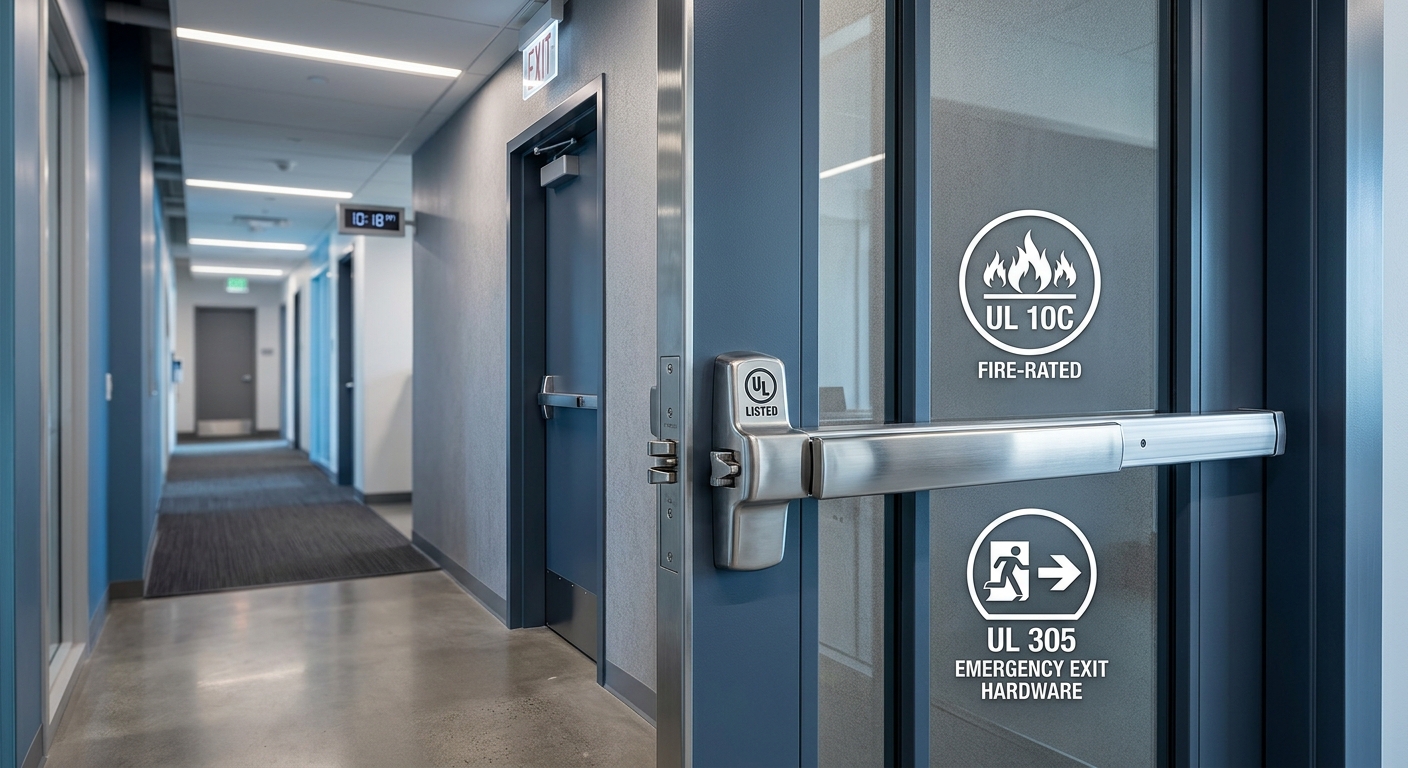
UL 305 is the standard specifically governing panic hardware and fire exit hardware—the push bars and crossbar devices you see on emergency exit doors in schools, offices, hospitals, and retail spaces.
The purpose of UL 305 is straightforward: in an emergency, people need to exit a building quickly without fumbling with a lock or latch. Panic hardware certified under UL 305 is tested to confirm that:
The door releases with a single motion applied to the crossbar or push pad
The hardware holds up under repeated, forceful operation (simulating a crowd pushing against it during an evacuation)
The mechanism continues to function reliably after extensive cycle testing
Fire exit hardware variants also maintain the door's fire-resistance rating when installed on a rated fire door
Building codes, including the International Building Code (IBC) and NFPA 101 (Life Safety Code), typically require UL 305-certified panic hardware on doors serving high-occupancy spaces like assembly rooms, classrooms, and egress stairwells. If a door is both an emergency exit and part of a fire-rated wall assembly, it needs fire exit hardware specifically—not standard panic hardware—because only the fire exit hardware variant has been tested to preserve the door's fire rating.
What Is UL 10C? Positive Pressure Fire Door Testing
UL 10C is a different animal entirely. Rather than focusing on egress speed, UL 10C evaluates how an entire fire door assembly—door, frame, and hardware together—performs when exposed to fire under positive pressure conditions.
Older fire testing standards, like UL 10B, tested fire doors under neutral or negative pressure, which didn't accurately reflect real fire conditions. Research showed that fires create positive pressure that pushes smoke and flame through gaps rather than pulling them away. UL 10C corrected this by testing door assemblies under conditions that more closely mirror an actual building fire, including pressure differentials at the top of the door opening where real fires tend to concentrate heat.
A UL 10C-rated door assembly must demonstrate that it can maintain its fire-resistance rating—commonly 20, 45, 60, 90, or 180 minutes—without allowing flame or excessive heat transfer through the assembly, including around the hardware penetrations like locks, hinges, and closers.
Choose UL 10C-rated assemblies when a door is part of a fire-rated wall or corridor system, since most modern building codes have adopted UL 10C (or the equivalent NFPA 252 positive pressure test) as the required standard for rated door assemblies. Pairing non-rated hardware with a UL 10C door frame voids the assembly's rating entirely, even if the door and frame themselves are certified.
UL 305 vs. UL 10C: Which One Applies to Your Project?
These two standards aren't competing options—they often apply together on the same door. A fire-rated exit door in a stairwell, for instance, typically needs:
UL 10C certification for the door, frame, and hardware as an assembly, confirming the fire rating holds under positive pressure
UL 305 fire exit hardware specifically, so the panic mechanism doesn't compromise that fire rating while still enabling fast egress
The key distinction: UL 305 is about how quickly and reliably people can exit through hardware, while UL 10C is about whether the entire door assembly resists fire spread. A door can be UL 305-compliant without being part of a fire-rated assembly at all (a standard panic-equipped exit on a non-rated wall), and a door can be UL 10C-rated without needing panic hardware if it isn't an emergency egress point.
How to Verify a UL Certification Is Legitimate
Counterfeit and mislabeled hardware is a real problem in commercial construction, particularly with imported products. Before accepting a shipment of "UL Listed" door hardware, verify the certification through these steps:
Check the UL Online Certifications Directory. UL maintains a free, searchable database at certifications.ul.com where you can look up any certified product by its UL file number, category code, or manufacturer name.
Confirm the file number matches the product. Every legitimately certified product carries a UL file number printed on the product label or in its documentation. Cross-reference this number in the UL database to confirm it corresponds to the exact model and category you've received—not just a similar product from the same manufacturer.
Look for the correct mark type. Confirm whether the product should carry a Listed, Recognized, or Classified mark based on its intended use, and check that the physical label matches what the database shows.
Verify the category code. UL categorizes products by function (panic hardware, fire door hardware, electric strikes, etc.). A mismatched category code is a red flag that the label may not apply to the product it's attached to.
Request a copy of the manufacturer's UL certificate directly if you have any doubt, especially for large commercial orders where multiple hardware types are being supplied together.
What Happens If You Install Non-UL-Certified Hardware?
Skipping proper UL certification on commercial door hardware creates risk on three fronts: code compliance, project acceptance, and insurance coverage.
Failed inspections and project delays. Fire marshals and building inspectors routinely check door hardware labels during final inspections. Non-certified or mismatched hardware on a fire-rated door assembly is one of the most common reasons commercial projects fail final inspection, forcing contractors to remove and replace hardware after installation—an expensive and time-consuming rework.
Voided fire ratings. Installing hardware that isn't rated for the specific door assembly—even hardware that's UL certified for a different application—can void the entire door's fire rating. A UL 10C-rated door fitted with non-rated hinges or a non-rated lock is, functionally, no longer a fire-rated door, regardless of what the door slab itself is rated for.
Insurance and liability exposure. Commercial property insurers often require code-compliant fire protection systems, including door assemblies, as a condition of coverage. If a fire occurs and investigators determine that non-certified hardware contributed to the spread of fire or smoke, insurers may deny claims or reduce payouts. In the event of injury or death linked to hardware failure during an evacuation, non-compliant panic hardware can also expose building owners and contractors to significant liability.
Reputational and financial cost for contractors. For hardware suppliers and installers, a pattern of non-compliant installations can damage client relationships and professional licensing standing, particularly in jurisdictions with strict life safety code enforcement.
Specifying the Right UL Certification for Your Project
Getting UL certification right starts at the specification stage, not after hardware arrives on site. Work with your architect or hardware consultant to identify every door that falls into a life safety category—emergency egress, fire separation, or both—and specify the exact UL standard required for each: UL 305 for panic and fire exit hardware, UL 10C for the fire-rated assembly as a whole, or both together where doors serve dual purposes.
Before ordering, request UL file numbers from your hardware supplier and verify them in the UL Online Certifications Directory. This single step catches most compliance issues before they become expensive change orders or failed inspections. A door assembly that passes inspection the first time protects your project timeline today and protects building occupants for decades to come.
Frequently Asked Questions
What is the difference between UL Listed and UL Classified door hardware?
UL Listed hardware is tested as a complete, standalone product against UL's full safety requirements. UL Classified hardware, by contrast, is evaluated against specific properties—most commonly fire resistance—rather than comprehensive safety criteria. Fire doors and related hardware are frequently UL Classified rather than UL Listed because the testing scope is narrower and fire-performance specific.
Do I need both UL 305 and UL 10C certification on the same door?
Yes, if the door is both a fire-rated assembly and an emergency exit. The door, frame, and hardware together need UL 10C certification to maintain the fire rating, while the panic or exit hardware itself needs UL 305 fire exit hardware certification to ensure it doesn't compromise that rating while still enabling fast egress.
How much does non-compliant door hardware cost to fix after installation?
Costs vary by project size, but rework typically includes removing and disposing of non-compliant hardware, sourcing certified replacements (often at expedited shipping rates), and re-scheduling inspections. On a mid-size commercial project, this can add weeks to the schedule and tens of thousands of dollars in labor and material costs, on top of potential contractual penalties for missed deadlines.
Can I verify UL certification myself, or do I need a professional?
You can verify UL certification yourself using the free UL Online Certifications Directory at certifications.ul.com. Search by UL file number, manufacturer name, or product category to confirm a certification is current and matches the product in hand. No professional credentials are required to use the database.
What happens if non-UL hardware is discovered after a fire incident?
Insurance investigators and fire marshals routinely review door hardware certification as part of post-incident reporting. If non-certified hardware is found to have contributed to fire or smoke spread, or to have failed during evacuation, building owners may face denied insurance claims, code violation citations, and potential liability in the event of injury or death.


KEYMAN is Your Choice Of Security!
If you have any questions regarding our products or services, please leave your details and our team will respond to you.
: +86-13823964887
: +86-13823964887


