
An ANSI Grade 1 mortise lock is the highest-performing classification under the ANSI/BHMA A156.13 standard, built to survive 1,000,000 open-close cycles and withstand a 360-pound force test — making it the required specification for schools, hospitals, government buildings, and other high-traffic commercial facilities. Grade 2 mortise locks meet a lower threshold (800,000 cycles) and suit lighter-duty commercial settings. Understanding exactly where these two grades diverge is essential for architects, specifiers, and facility managers choosing hardware that must perform reliably under heavy, continuous use.
What Is the ANSI/BHMA A156.13 Mortise Lock Standard?
ANSI/BHMA A156.13 is the American National Standards Institute and Builders Hardware Manufacturers Association standard governing mortise lock performance, safety, and durability. Any mortise lock marketed for commercial use in the U.S. is typically certified against this standard, which defines measurable benchmarks a lock must pass before it can carry a Grade 1, Grade 2, or Grade 3 rating.
Unlike cylindrical locksets, mortise locks house the entire lock mechanism in a rectangular pocket cut into the door edge, allowing for more complex functions — multipoint latching, deadbolt integration, and reinforced strike plates — that make them a preferred choice for doors exposed to frequent use or elevated security risk.
What Test Categories Does ANSI/BHMA A156.13 Cover?
ANSI/BHMA A156.13 evaluates mortise locks across four core testing categories, and a lock must pass all four at a given tier to earn that grade designation:
Cycle (Operational) Testing — Measures how many times the lock can be locked, unlocked, and latched before failure. This is the single most-cited benchmark distinguishing Grade 1 from Grade 2.
Strength Testing — Applies static force and impact loads to the latch, deadbolt, and lever/knob assembly to confirm the lock resists forced entry and daily wear.
Security Testing — Assesses resistance to drilling, sawing, and manipulation of the lock cylinder and bolt mechanism.
Material and Finish Testing — Evaluates corrosion resistance and finish durability to ensure long-term performance in varied environmental conditions.
Each category has its own pass/fail thresholds per grade, which is why a lock cannot be "partially" Grade 1 — it must meet the full battery of tests at that tier.
What's the Difference Between Grade 1 and Grade 2 Mortise Locks?
The primary difference between Grade 1 and Grade 2 mortise locks lies in cycle durability and strength tolerance: Grade 1 locks are tested to 1,000,000 cycles and a 360-pound force threshold, while Grade 2 locks are tested to 800,000 cycles with a lower force requirement.
Test Parameter | ANSI Grade 1 | ANSI Grade 2 |
|---|---|---|
Cycle Testing | 1,000,000 cycles | 800,000 cycles |
Force/Strength Test | 360 lbs | Lower force threshold |
Typical Application | High-traffic commercial, institutional, government | Light-to-moderate commercial use |
Recommended For | Schools, hospitals, government facilities, high-security doors | Office buildings, retail, low-traffic commercial entries |
Grade 1 mortise locks are better suited for facilities where door hardware is cycled constantly throughout the day and where failure carries safety or security consequences, while Grade 2 locks work best in settings with moderate foot traffic and lower liability exposure, such as small retail stores or low-traffic office suites.
Which Facilities Must Specify Grade 1 Mortise Locks?
Building codes, insurance requirements, and institutional procurement standards frequently mandate Grade 1 mortise locks for facilities where door hardware failure poses a safety, security, or liability risk. Common examples include:
Schools and universities — high-cycle traffic combined with lockdown security requirements
Hospitals and healthcare facilities — continuous use across patient rooms, labs, and restricted-access corridors
Government buildings — elevated security classifications often require Grade 1 as a baseline
High-traffic commercial corridors — airports, transit hubs, and large office towers where doors cycle thousands of times daily
For these environments, specifying anything below Grade 1 risks premature hardware failure, increased maintenance costs, and potential non-compliance with facility security codes.
How Does the Keyman M7 Series Meet Grade 1 Requirements?
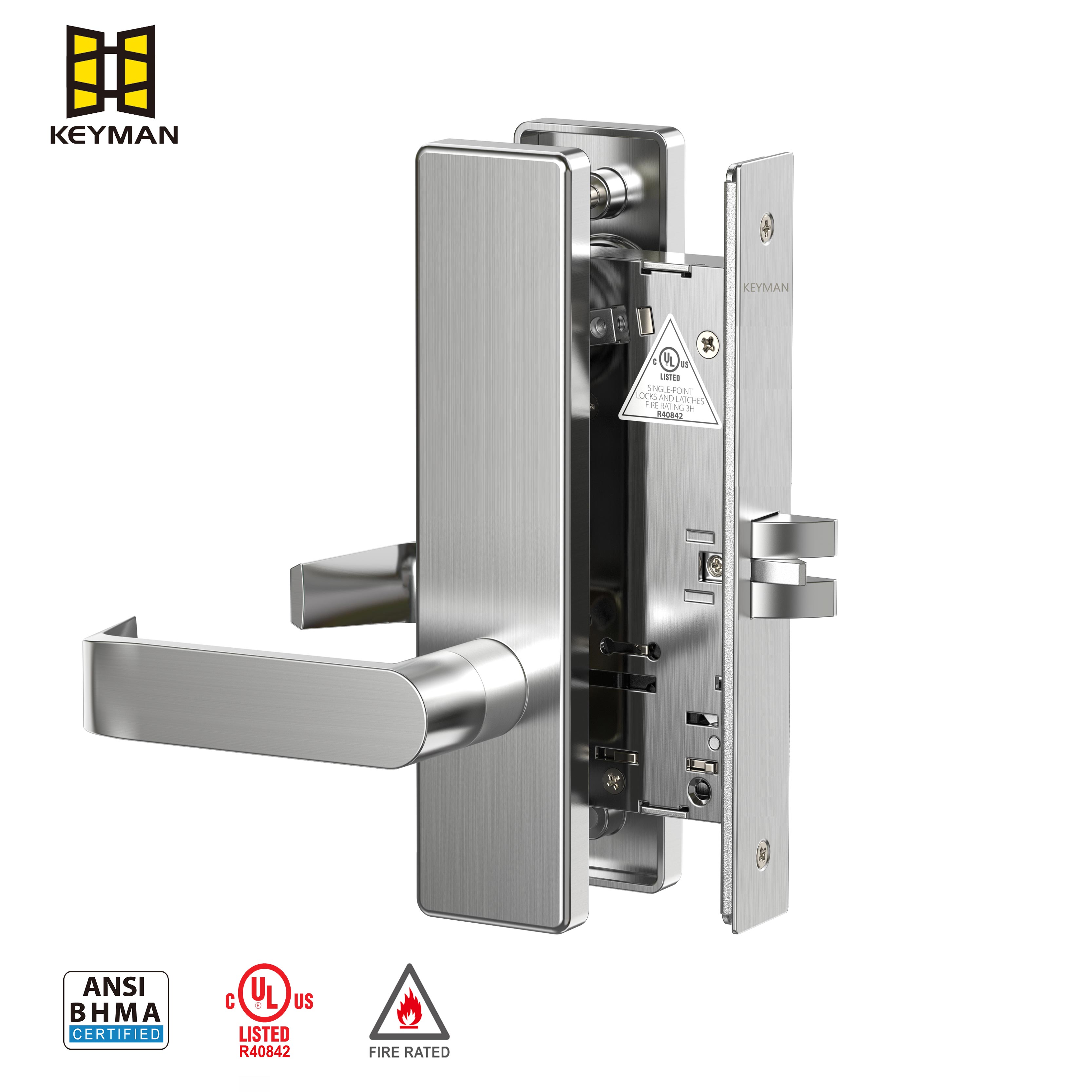
The Keyman M7 Series is engineered to meet ANSI/BHMA A156.13 Grade 1 certification in full, including the 1,000,000-cycle operational test and the 360-pound strength threshold required for the highest commercial tier. Beyond the core mortise lock standard, the M7 Series also carries a UL 10C 3-hour fire rating, making it suitable for fire-rated door assemblies in addition to standard high-traffic commercial applications.
This combination — Grade 1 mechanical durability plus fire-rated certification — positions the M7 Series as a specification-ready solution for architects and facility managers sourcing hardware for schools, hospitals, government buildings, and other projects where both security performance and life-safety compliance are non-negotiable. For full product specifications, visit Keyman Lock.
Frequently Asked Questions
Can a Grade 2 mortise lock be upgraded to Grade 1 performance after installation?
No. Grade certification is tied to the lock's internal mechanism and construction as tested by ANSI/BHMA A156.13, so a Grade 2 lock cannot be field-modified to meet Grade 1 standards — the entire unit must be replaced with a certified Grade 1 product.
Does ANSI/BHMA A156.13 certification expire or require retesting?
Certification applies to a specific lock model and manufacturing specification; if a manufacturer changes the lock's materials or mechanism, the product must be retested to retain its grade rating, though an installed lock itself does not "expire."
Is Grade 1 required by building code, or is it a best-practice recommendation?
Requirements vary by jurisdiction and occupancy type — many local codes and insurance underwriters mandate Grade 1 for high-occupancy or life-safety-critical buildings, while in other cases it's a best-practice specification rather than a strict legal requirement, so architects should confirm local code requirements during the specification phase.
What's the difference between an ANSI grade rating and a UL fire rating on the same lock?
The ANSI/BHMA A156.13 grade (1, 2, or 3) measures mechanical durability and security performance, while a UL fire rating (such as UL 10C) certifies the lock's ability to maintain door integrity during a fire — a lock like the Keyman M7 Series can hold both certifications simultaneously since they test entirely different performance criteria.


KEYMAN is Your Choice Of Security!
If you have any questions regarding our products or services, please leave your details and our team will respond to you.
: +86-13823964887
: +86-13823964887


