
TL;DR:
An SFIC lock cylinder is a cylinder housing built to accept a Small Format Interchangeable Core (SFIC), letting facility managers swap out the core—and rekey the lock—without removing the whole cylinder from the door. Also called an IC core lock cylinder, this design is standard in commercial master key systems used across offices, schools, hospitals, and government buildings.
If you manage security across a large building or a portfolio of properties, rekeying can be a logistical headache. Every lost key, employee turnover, or security breach traditionally means calling a locksmith to pull cylinders apart, pin by pin. The SFIC lock cylinder was engineered to solve exactly this problem.
Small Format Interchangeable Core systems separate the "core" (the part that holds the pins and accepts the key) from the "housing" (the shell mounted in the door). That separation means a trained staff member, not necessarily a locksmith, can pull a core out with a control key and drop in a new one in seconds. For organizations managing dozens or hundreds of doors, that difference adds up to real savings in time and maintenance costs.
This guide breaks down what an SFIC lock cylinder is, how it works, where it's used, and what to look for when sourcing IC core lock cylinders for a commercial project.
What Does SFIC Stand For in Lock Hardware?
SFIC stands for Small Format Interchangeable Core. It refers to a compact, standardized core format—originally developed by Best Lock Corporation—that fits into a wide range of cylinder housings across different hardware brands and manufacturers.
Because the SFIC format is standardized, a Small Format Interchangeable Core from one compatible manufacturer will generally fit housings from another, as long as both follow the same dimensional specifications. This interchangeability is the whole point of the system: one core format, many housing types, consistent compatibility across a building's entire door hardware lineup.
How Does an SFIC Cylinder Housing Work?
An SFIC cylinder housing is the shell that holds the SFIC core in place within a lock, exit device, or mortise chassis. The housing itself doesn't contain pins or do the "locking" work—it's the SFIC core, inserted into that housing, that holds the pin tumblers and interacts with the key.
Here's the sequence in practice:
The housing is installed in the door hardware—rim cylinder, mortise cylinder, or exit device trim—just like a standard cylinder.
A core is inserted into the housing's figure-8-shaped chamber.
A control key removes the core when a rekey is needed, without disturbing the housing or the surrounding door hardware.
A new core is dropped in, instantly changing the key system for that door.
This modular approach is why SFIC lock cylinders dominate institutional and commercial settings where master key systems need to flex and adapt over time.
What Materials Are SFIC Cylinder Housings Made From?
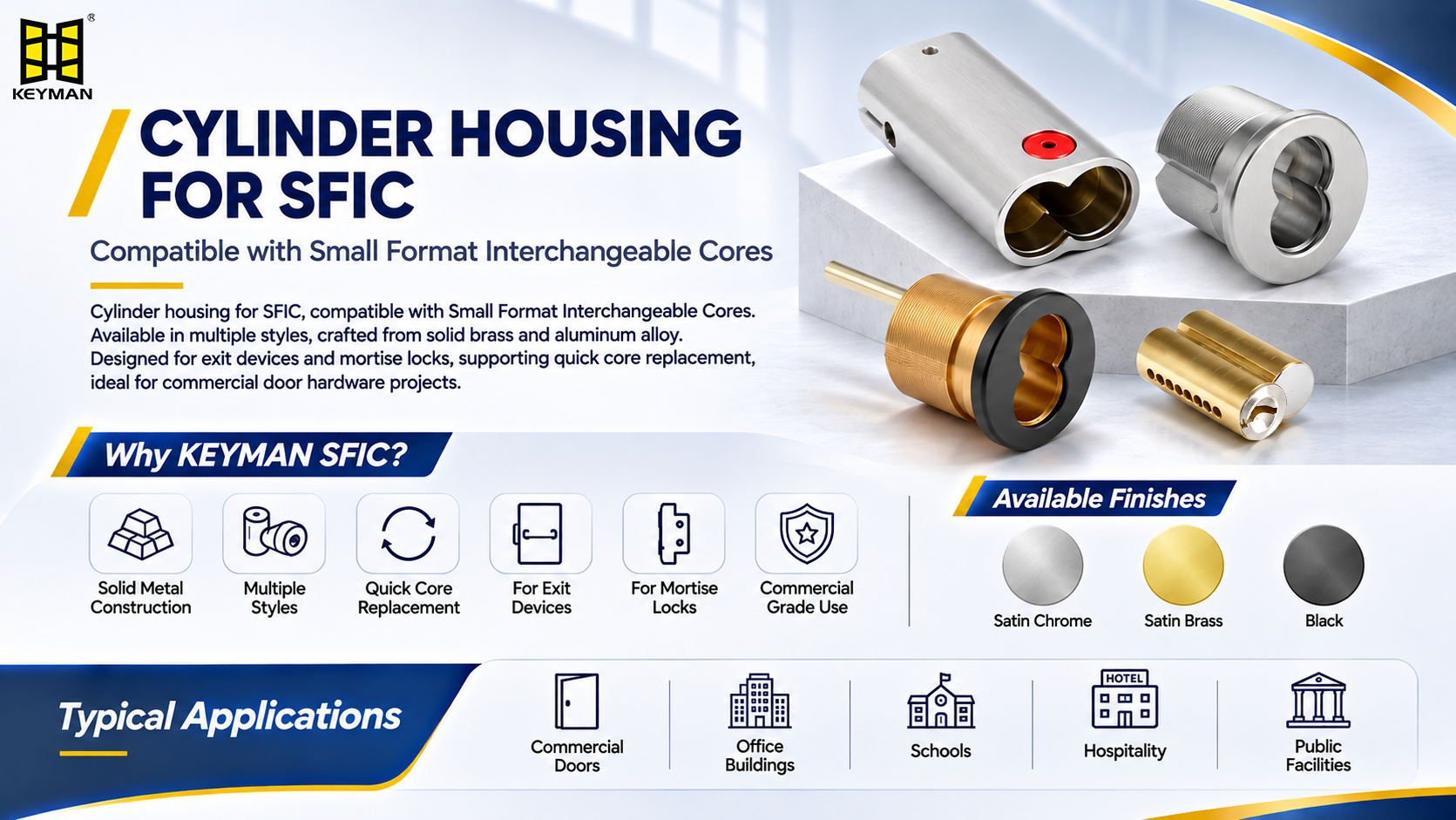
Commercial-grade SFIC cylinder housings are typically crafted from solid brass and aluminum alloy. Brass offers corrosion resistance and long-term durability under heavy use, while aluminum alloy housings reduce weight without sacrificing structural integrity. Keyman Lock, for example, produces SFIC cylinder housings in both materials, giving specifiers flexibility depending on application and budget.
Where Are SFIC Core Lock Cylinders Typically Used?
SFIC core lock cylinders are built for commercial and institutional environments where door hardware needs to be reliable, serviceable, and easy to rekey at scale. Typical applications include:
Commercial doors in retail and mixed-use buildings
Office buildings with multi-tenant access requirements
Schools, where security protocols and access levels change frequently
Hospitality properties, including hotels with high guest turnover
Public facilities, such as government offices and civic buildings
Choose an SFIC-based system if your building has many doors, multiple access tiers, or an ongoing need to rekey without replacing hardware. For a single residential door with infrequent rekeying needs, a standard conventional cylinder is usually simpler and more cost-effective.
Why Choose an SFIC Lock Cylinder Over a Conventional Cylinder?
Conventional cylinders require full removal and disassembly to rekey—a job that typically needs a locksmith and downtime for the door. SFIC lock cylinders remove that bottleneck. Because the core pulls out independently of the housing, in-house security or facilities staff can manage rekeying directly, cutting both labor costs and response time after a lost key or staff turnover event.
SFIC systems also support more sophisticated master key hierarchies. A single building can run grand master keys, master keys, and individual change keys across dozens of doors, with each core swappable on its own schedule. This is why SFIC hardware has become the default standard for institutional access control in North America.
What Styles and Finishes Are Available for SFIC Cylinder Housings?
SFIC cylinder housings are available in multiple configurations to fit different door hardware types, including rim cylinders for exit devices and mortise cylinders for mortise locks. Finish options commonly include satin chrome, satin brass, and black, allowing the hardware to match a building's existing door hardware aesthetic while maintaining functional consistency across the property.
Sourcing SFIC Lock Cylinders for Commercial Projects
For hardware distributors, locksmiths, and contractors sourcing SFIC lock cylinders at scale, consistency and manufacturing quality matter as much as price. Zhongshan Keyman Locks Products Ltd., operating under the Keyman Lock brand, manufactures SFIC cylinder housings designed for compatibility with Small Format Interchangeable Cores, built from solid brass and aluminum alloy for exit devices and mortise locks. These housings support quick core replacement and are designed for commercial-grade use across office buildings, schools, hospitality properties, and public facilities.
If your next project calls for dependable IC core lock cylinders, Keyman Lock's SFIC product line is built specifically around the durability and interchangeability that commercial master key systems demand.
Making the Right Call on SFIC Hardware
An SFIC lock cylinder isn't just a cylinder—it's a long-term access control strategy. The upfront investment in SFIC-compatible housings pays off every time a key is lost, an employee leaves, or a tenant changes, because rekeying becomes a five-minute task instead of a service call. For any facility manager overseeing multiple doors, that operational flexibility is worth building into the hardware spec from day one.
Before your next hardware order, confirm the housing material, finish options, and core compatibility align with your building's existing master key system—and reach out to a manufacturer like Keyman Lock to review which SFIC configuration fits your specific exit devices or mortise locks.
Frequently Asked Questions
What's the difference between an SFIC core and an SFIC cylinder housing?
The SFIC core is the removable component containing the pin tumblers that interact with the key. The cylinder housing is the shell installed in the door hardware that holds the core in place. The core can be swapped independently of the housing.
Can any SFIC core fit any SFIC housing?
Generally, yes—SFIC is a standardized format, so cores and housings built to the same dimensional specification are interchangeable across compatible manufacturers. Always confirm compatibility specifications with the manufacturer before mixing brands.
Who typically removes and replaces an SFIC core?
Facility staff or a security administrator holding the control key can remove and replace an SFIC core, without needing a locksmith for routine rekeying.
Is an SFIC lock cylinder suitable for residential use?
SFIC lock cylinders are designed primarily for commercial and institutional settings with complex master key needs. For a single-family home, a standard residential cylinder is typically more practical and cost-effective.
What materials should I look for in a commercial SFIC cylinder housing?
Solid brass and aluminum alloy are the standard materials for commercial-grade SFIC cylinder housings, offering durability and corrosion resistance suited to high-traffic doors.

KEYMAN is Your Choice Of Security!
If you have any questions regarding our products or services, please leave your details and our team will respond to you.
: +86-13823964887
: +86-13823964887


