
TL;DR:
Full Mortise-Mount Pivot Hinges are the heavy-duty hardware of choice for commercial door pivot hardware, concealing the pivot mechanism inside the door and jamb for a clean, flush finish. Keyman Lock's KPH Series pairs a handed mortise middle pivot with a 3/4" offset pivot set to support loads up to 600 pounds, door swings beyond 180 degrees, and years of reliable service thanks to SUS 304 stainless steel construction.
Commercial doors don't get an easy life. They swing open hundreds of times a day, carry the weight of security glazing or lead lining, and still need to look sharp for visitors walking through the lobby. Standard butt hinges struggle under that combination of weight and frequency, which is exactly why specifiers are turning to a modern pivot door hinge system instead of surface-mounted alternatives.
Full Mortise-Mount Pivot Hinges solve this by recessing the hardware directly into the door and frame, distributing weight through a pivot point rather than a hinge pin. For architects, contractors, and facility managers comparing commercial door pivot hardware, understanding how this system works—and where it fits best—can prevent costly hardware failures down the line.
What Makes a Pivot Hinge "Full Mortise-Mount"?
A full mortise-mount pivot hinge is cut, or mortised, directly into the side jamb and the hinge edge of the door rather than screwed onto the surface. This creates a flush, low-profile look while shifting the door's weight onto a pivoting mechanism built for heavier loads than a traditional pin hinge can handle.
Keyman Lock's KPH Series is a clear example of this approach in action. Rather than a single hinge, it's a coordinated two-part system:
KPH30 Middle Pivot — A handed (RH/LH) mortise pivot that fits into the side jamb and hinge edge of the door, keeping the door tracking true as it swings.
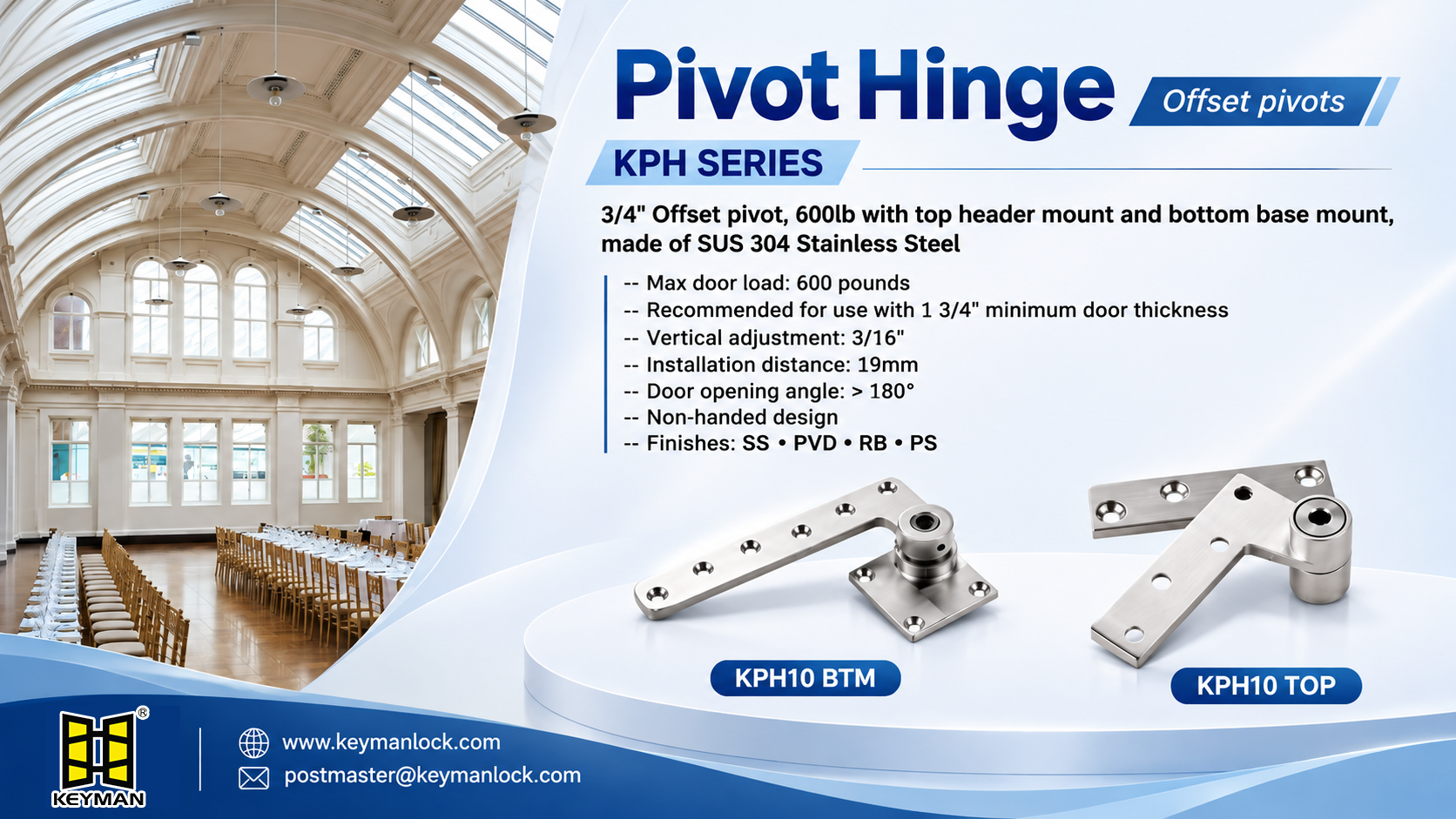
KPH10 Offset Pivot Set — A 3/4" (19mm) offset pivot assembly with a top header mount and bottom base mount, sold as a matched, compatible pair.
This isn't hardware pulled together from mismatched sources. It's engineered as a set specifically for heavy-duty applications: large commercial entrances, institutional buildings, and any doorway that sees constant use.
How Does an Offset Pivot Hinge System Improve Door Performance?
Unlike a center-hung pivot, an offset pivot hinge places the pivot axis away from the edge of the door rather than directly on it. That small shift in geometry delivers two big advantages for commercial door pivot hardware.
Choose an offset configuration if your project needs maximum clearance and a sleek, modern look. The 3/4" offset on the KPH10 opens up a wider clearance gap and lets the door swing past 180 degrees, so it clears the frame entirely. That matters in loading docks, institutional corridors, and busy commercial entries where every inch of clearance counts.
The KPH10 set is rated for a maximum door load of 600 pounds and is built for doors at least 1 3/4 inches thick, making it a strong fit for extra-heavy interior doors, including lead-lined applications where weight capacity isn't negotiable.
Key specifications include:
Maximum door load: 600 pounds
Installation distance: 19mm
Vertical adjustment range: 3/16" for fine-tuning after install
Door opening angle: greater than 180 degrees
Design: non-handed, so it installs on either left- or right-swinging doors
Finishes: stainless steel (SS), PVD, RB, and PS
Doors taller than 1524mm (60") need an intermediate pivot for every additional 762mm (30") of height, and door edges must be beveled 3mm (1/8") in 51mm (2"). Custom spindle extensions are also available when a project calls for something outside the standard range.

Why Does the KPH30 Middle Pivot Matter for Door Alignment?
While the offset pivot set carries the door's weight at the top and bottom, the KPH30 middle pivot mortises into the side jamb and the hinge edge of the door itself. Because it's handed—available as KPH30RH or KPH30LH—it's built to match the door's specific swing direction rather than acting as a generic, one-size-fits-all part.
That middle pivot plays an outsized role over the life of the door. Alignment drift after thousands of open-close cycles is one of the most common reasons commercial door hardware fails early. The KPH30's mortise design, combined with heavy-duty stainless steel needle bearings, cuts down friction at the pivot point and helps the door hold its intended swing path for years rather than months.
Does Stainless Steel Construction Actually Matter for Pivot Hinges?
Material selection decides how long any hardware system lasts in the real world, and entryways are not a gentle environment. They face constant handling, humidity, and temperature swings every single day.
The KPH Series is built from SUS 304 stainless steel, a grade recognized for its strong corrosion resistance. For building owners, that translates directly into fewer hardware replacements and lower maintenance costs over the building's lifetime compared to standard steel or aluminum alternatives.
The system also relies on heavy duty stainless steel needle bearings at each pivot point. Those bearings reduce friction during operation, which means a smoother swing and less mechanical stress on the hinge assembly with every use.
Who Actually Needs This Kind of Heavy-Duty Pivot System?
Choose a full mortise-mount pivot hinge system if your project involves large, heavy commercial or institutional doors that need to perform reliably under constant use. This covers:
High-traffic commercial entrances
Institutional buildings where durability is a long-term investment, not a one-time purchase
Extra-heavy interior doors, including lead-lined applications
Projects that require a door opening angle greater than 180 degrees for full clearance
If your doors are lighter-duty with minimal traffic, a standard butt hinge may do the job at a lower cost. But for doors where hardware failure isn't an acceptable risk, a system engineered for 600-pound loads offers a level of reliability lighter hardware simply can't match.
What Should Installers Keep in Mind?
Specifying the right hardware is only half the job—installation details matter just as much:
The KPH10 set has a fixed 19mm installation distance, so precise fitting is essential.
The 3/16" vertical adjustment range allows for fine-tuning after the door is hung, which helps with doors that settle slightly over time.
Because the KPH10 is non-handed, installers have flexibility across multiple door configurations on the same job site.
The KPH30 middle pivot is handed, so confirming RH or LH before installation is a must to match the door's swing direction.
Sourcing a complete, matched set from one manufacturer—rather than combining parts from different suppliers—reduces the risk of fit or performance issues once the door is in daily use.
The Case for Investing in the Right Pivot Hardware
Full Mortise-Mount Pivot Hinges exist to solve a specific problem: standard hardware was never designed to carry the weight, traffic, and longevity demands of commercial and institutional doors. Keyman Lock's KPH Series addresses this with a coordinated system—a handed middle pivot and a non-handed offset pivot set, both built from corrosion-resistant stainless steel and rated for 600-pound loads.
Whether you're specifying hardware for a new commercial build or replacing aging hinges on an existing institutional entrance, understanding how a modern pivot door hinge system distributes weight and maintains alignment puts you in a stronger position to make the right call.
For full specifications, available finishes, or a quote on the KPH Series, visit Keyman Lock's website or contact the Zhongshan Keyman Locks Products Ltd. team directly.
Frequently Asked Questions
How much weight can a full mortise-mount pivot hinge support?
The KPH Series offset pivot set supports a maximum door load of 600 pounds, making it suitable for extra-heavy interior doors, including lead-lined applications.
What's the difference between the KPH30 and KPH10 components?
The KPH30 is a handed (RH/LH) middle pivot that mortises into the door's side jamb and hinge edge to maintain alignment. The KPH10 is a non-handed, 3/4" offset pivot set made up of a top header mount and bottom base mount that carries the door's primary load.
What door thickness does this hinge system require?
The KPH10 offset pivot set is recommended for doors at least 1 3/4 inches thick.
Is this pivot hinge system resistant to corrosion?
Yes. The KPH Series is constructed from SUS 304 stainless steel, which offers strong corrosion resistance for demanding commercial environments.
How wide can the door swing open with this system?
The KPH10 offset design allows a door opening angle greater than 180 degrees, letting the door swing fully clear of the frame.
Do taller doors need extra hardware?
Yes. Doors over 1524mm (60") tall require an intermediate pivot for each additional 762mm (30") of height or fraction thereof.


KEYMAN is Your Choice Of Security!
If you have any questions regarding our products or services, please leave your details and our team will respond to you.
: +86-13823964887
: +86-13823964887


