
Quick answer:
Mortise locksets fit into a pocket cut inside the door and deliver ANSI Grade 1 strength, making them the standard choice for commercial fire door lock applications on hotels, high-traffic entries, and fire-rated openings. Cylindrical locksets are bored straight through the door, install faster, cost less upfront, and suit offices, storage rooms, and lower-traffic interior doors. The right pick depends on traffic volume, security grade, and budget.
Choosing between a mortise lockset vs cylindrical lockset isn't just a matter of preference — it's a decision that affects door longevity, code compliance, and total cost of ownership. Facility managers, architects, and door hardware distributors face this exact question every time a commercial project calls for new lock bodies, and getting it wrong can mean premature hardware failure or a failed fire inspection.
This guide breaks down the structural differences, durability expectations, and ideal use cases for each lock type, so you can match the right lock body to the right door — the first time.
What's the Structural Difference Between a Mortise Lock and a Cylindrical Lock?
The core distinction in any mortise vs cylindrical lockset comparison comes down to how the lock body sits inside the door.
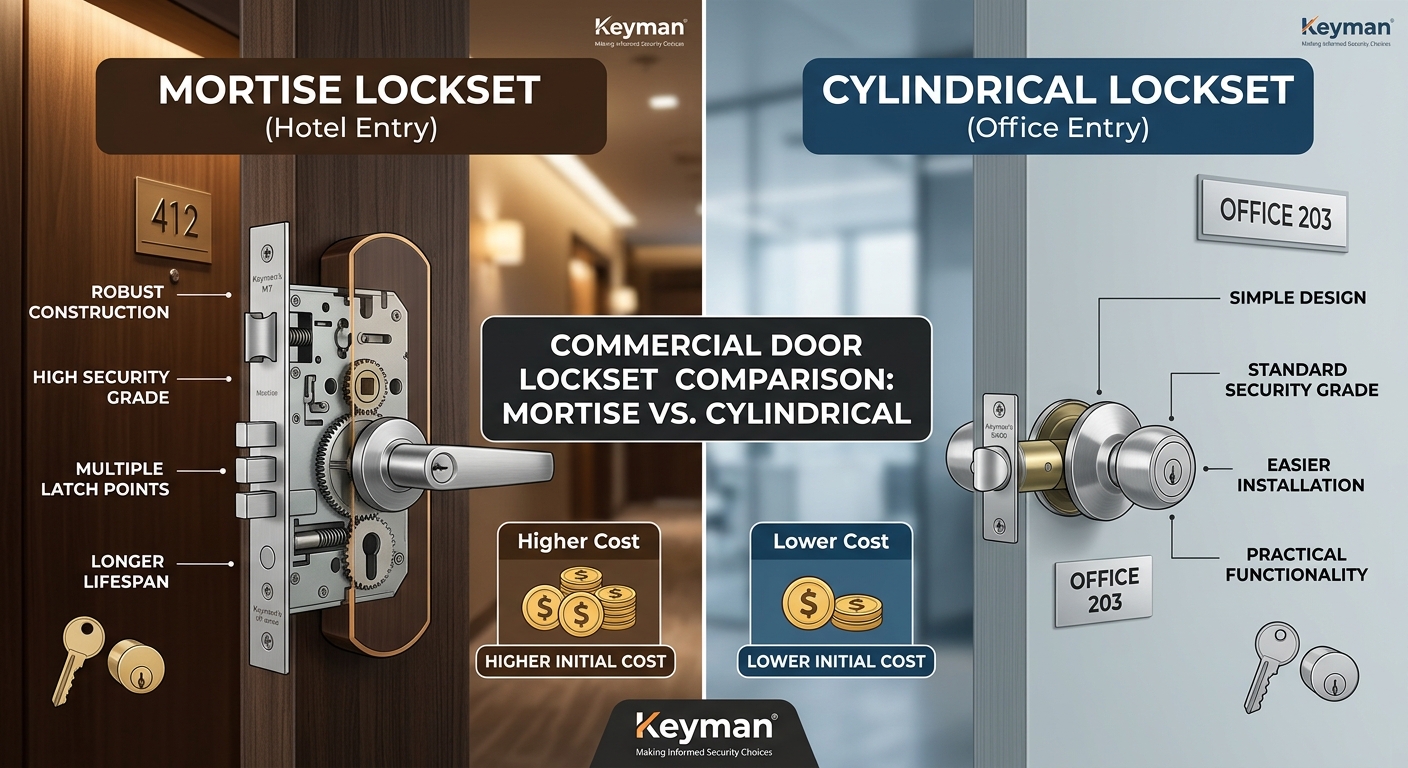
A mortise lockset requires a rectangular pocket (the "mortise") to be cut into the edge of the door. The entire lock case — latch, deadbolt, and often an auxiliary function — sits inside this pocket as a single integrated unit. This construction is inherently more robust because the lock mechanism is housed within solid door material on multiple sides.
A cylindrical lockset, by contrast, is installed through two round holes bored into the face and edge of the door. The lock components — latch, cylinder, and spring — are separate parts that connect through the door rather than sitting in one unified case. This is faster to install but offers less structural reinforcement than a mortise pocket.
How Do Mortise and Cylindrical Locks Compare on Durability and Security Grade?
Durability is where the mortise lockset vs cylindrical debate becomes most relevant for commercial buyers.
Mortise locks are almost always built to ANSI Grade 1, the highest commercial security rating under ANSI/BHMA A156.13. Keyman's M7 Series, for example, is a UL-listed ANSI Grade 1 mortise lock rated for 3-hour fire doors under ANSI/UL 10C and CAN/ULC-S104 — making it a strong fit anywhere a commercial fire door lock is required.
Cylindrical locks span a wider range, typically Grade 1 or Grade 2, depending on the product line. Grade 2 cylindrical locks, like Keyman's B400 Series, are built for solid everyday performance but are generally specified for lower-traffic or lower-risk openings rather than primary entrances.
In practical terms: mortise locks tend to outlast cylindrical locks in high-cycle environments because their internal components are better protected from everyday stress and more repairable without replacing the whole unit.
Which Commercial Spaces Need a Mortise Lock vs a Cylindrical Lock?
Matching lock type to door function prevents both overspending and premature hardware failure. Here's a quick scenario matrix:
Choose a mortise lockset if:
The door is a primary hotel guestroom or corridor entry
The opening sees high daily traffic (main lobbies, stairwells, public corridors)
The door is fire-rated and needs a certified commercial fire door lock
Long-term durability matters more than upfront installation speed
Choose a cylindrical lockset if:
The door is an office, conference room, or private workspace
The opening is a storage room, closet, or back-of-house access point
The project has a tighter hardware budget or installation timeline
Traffic volume is low to moderate
A hospitality property with constant guest and staff traffic should lean toward Grade 1 mortise hardware like the M7 Series. An office building with internal doors that see a handful of daily openings is typically well served by a Grade 2 cylindrical lock like the B400 Series.
Is a Mortise Lock or Cylindrical Lock More Cost-Effective?
Cost comparisons in the mortise vs cylindrical lockset decision need to account for both upfront price and lifecycle expense.
Mortise locks carry a higher initial cost. The lock body is more complex, the door prep requires more precise machining, and installation takes longer. However, that investment pays off over time: mortise locks are built for higher cycle counts, are easier to service in place, and hold up better under constant use — which lowers long-term replacement and maintenance costs.
Cylindrical locks cost less upfront and install faster, since the bored-hole prep is simpler and quicker for installers. For doors with lower traffic and lower security demands, this makes cylindrical locks the more budget-efficient choice without sacrificing adequate performance.
The right decision comes down to a simple question: are you optimizing for lowest upfront cost, or lowest cost over the life of the door? High-traffic and fire-rated doors justify the mortise investment. Lower-traffic interior doors usually don't need it.
How Keyman's M7 and B400 Series Map to These Two Lock Types
Keyman's product lineup illustrates this comparison directly. The M7 Series is a UL-listed ANSI/BHMA A156.13 Grade 1 mortise lock, fire-rated to 3 hours under ANSI/UL 10C and CAN/ULC-S104 — a specification built for demanding commercial fire door lock applications where security and code compliance are non-negotiable.
The B400 Series represents Keyman's cylindrical lock line, built to ANSI Grade 2 standards for reliable everyday performance on lower-traffic commercial doors.
Specifying the M7 Series for primary entrances and fire-rated openings, and the B400 Series for secondary or interior doors, gives a facility a hardware strategy that matches security grade to actual door function — instead of over-speccing every opening or under-protecting the ones that need it most.
Making the Right Call for Your Next Door Hardware Project
The mortise lockset vs cylindrical question isn't about which lock is universally "better" — it's about matching the lock body to the door's job. High-traffic, fire-rated, and security-critical openings call for the strength and durability of a Grade 1 mortise lock. Lower-traffic interior doors are often better served by the speed and cost efficiency of a cylindrical lock.
Before finalizing a hardware schedule, walk through each door's traffic pattern, fire rating requirement, and budget constraints. Matching lock type door-by-door — rather than standardizing on one option across a whole building — is what keeps both compliance teams and facility budgets satisfied.
If you're specifying hardware for an upcoming commercial project, reviewing Keyman's M7 and B400 Series specifications side by side is a practical next step toward finalizing a code-compliant, cost-efficient lock schedule.
Frequently Asked Questions
Is a mortise lock more expensive than a cylindrical lock?
Yes, mortise locks generally cost more upfront due to more complex door prep and lock construction. However, their longer service life often lowers the total cost of ownership on high-traffic doors.
Do fire-rated commercial doors require a mortise lock?
Not always, but mortise locks are commonly specified for commercial fire door lock applications because many mortise lines, including Keyman's M7 Series, carry 3-hour fire ratings under ANSI/UL 10C and CAN/ULC-S104.
Can a cylindrical lock be used on a high-traffic commercial door?
It's not recommended for primary entrances or high-cycle openings. Cylindrical locks, particularly Grade 2 models, are better suited to lower-traffic interior doors like offices and storage rooms.
What's the main installation difference between the two lock types?
A mortise lock requires a pocket cut into the door edge, which takes more time and precision to install. A cylindrical lock uses two bored holes and installs faster with simpler door prep.
Which lock type lasts longer?
Mortise locks, especially ANSI Grade 1 models, typically outlast cylindrical locks in high-use commercial settings due to their reinforced internal construction and serviceability.


KEYMAN is Your Choice Of Security!
If you have any questions regarding our products or services, please leave your details and our team will respond to you.
: +86-13823964887
: +86-13823964887


