
Quick answer:
Choosing heavy duty pivot hinges comes down to matching the hinge's load rating to your door's actual weight, width-to-height ratio, and daily cycle count. For doors exceeding 250 lbs, look for a pivot set built from stainless steel or cast steel with a hardened bearing structure, and always calculate at least 20-30% weight redundancy beyond your door's measured weight before finalizing a spec.
Oversized doors fail for one reason more than any other: the hinge hardware underneath them was never built to carry the load in the first place. A glass entrance door, a steel fire-rated door, or a reinforced server room panel can easily weigh 250 to 500 lbs, and once you add high-traffic cycling into the mix, standard butt hinges simply wear out. Pivot hinges solve this problem by transferring weight through a vertical axis rather than side-mounted leaves, distributing stress more evenly and allowing doors to swing smoothly for years.
This guide walks through the practical factors that determine whether a pivot hinge will hold up under real-world conditions, including door weight, width-to-height proportions, and traffic frequency. We'll also look at what separates a genuinely heavy duty pivot set from one that only looks the part on a spec sheet.
Why door weight is the starting point for choosing pivot hinges for doors
Door weight determines nearly everything else in your hardware selection. A standard wood door might weigh 100-150 lbs, but solid-core commercial doors, steel doors, and glass doors with thick tempered panels routinely cross the 250 lb threshold. Some oversized architectural doors, like those used in hotel lobbies or institutional entrances, exceed 500 lbs.
Here's the calculation most specifiers overlook: the rated capacity printed on a pivot hinge's datasheet is a ceiling, not a target. If your door weighs 300 lbs, selecting a pivot set rated for exactly 300 lbs leaves no margin for wear, temperature expansion, or the extra torque generated by wind load on exterior doors. A better approach is to build in 20-30% redundancy, meaning a 300 lb door should sit on hardware rated for 360-390 lbs or higher.
Choose a cast steel or forged pivot set if your door exceeds 400 lbs and sees frequent use, since cast steel resists deformation under sustained compressive load better than lighter alloys. For doors in the 150-250 lb range with moderate traffic, a quality stainless steel pivot set is typically sufficient and offers better corrosion resistance for exterior applications.
How does door width-to-height ratio affect pivot hinge selection?
Weight alone doesn't tell the full story. A tall, narrow door and a short, wide door of the same weight place very different stresses on a pivot hinge. Wider doors generate more leverage at the pivot point because the center of mass sits farther from the hinge axis, which increases the torque the hinge has to resist every time the door swings.
As a practical guideline, doors with a width-to-height ratio greater than roughly 1:2.5 (meaning the door is proportionally wide relative to its height) should be treated as higher-stress applications, even if their total weight falls within a "standard" range. In these cases, specifying a pivot hinge with a larger bearing surface, like a 3/4-inch offset design, helps the hinge clear the frame properly while still distributing the added torque evenly across the pivot axis.
What role does traffic frequency play in hinge durability?
A door that opens 20 times a day wears very differently than one that opens 2,000 times a day. High-traffic environments, like hospital corridors, retail entrances, and office building lobbies, put repeated cyclical stress on the bearing surfaces inside a pivot hinge. Over time, inferior bearings develop play, which leads to sagging, binding, or misalignment.
This is where bearing structure becomes just as important as raw weight capacity. A heavy duty pivot set engineered with hardened steel bearings maintains smooth rotation through tens of thousands of cycles, while cheaper sleeve-style bearings degrade much faster under constant use. If your door sees more than a few hundred cycles per day, prioritize hinges explicitly rated for high-frequency commercial use rather than general-purpose residential hardware.

Calculating load redundancy before you buy a pivot set
Here's a simple framework for building redundancy into your hardware decision:
Weigh the door accurately. Don't estimate. Use the manufacturer's listed weight or a scale if the door is already fabricated.
Add 20-30% buffer to account for wear, environmental stress, and installation variables.
Factor in width-to-height ratio. If the door is proportionally wide, add an additional margin since torque increases with leverage.
Match the result to a pivot set's published load rating, not just its category name. "Heavy duty" is not a regulated term, so always check the actual weight rating in the datasheet.
Confirm the bearing type can handle your expected daily cycle count, especially for commercial or institutional doors.
Following this sequence prevents the most common and costly mistake in door hardware specification: under-rating the hinge because the door "looks standard" on paper.
What makes a pivot set genuinely heavy duty?
Not every hinge marketed as "heavy duty" is built the same way. The material and bearing construction make the real difference in long-term performance.
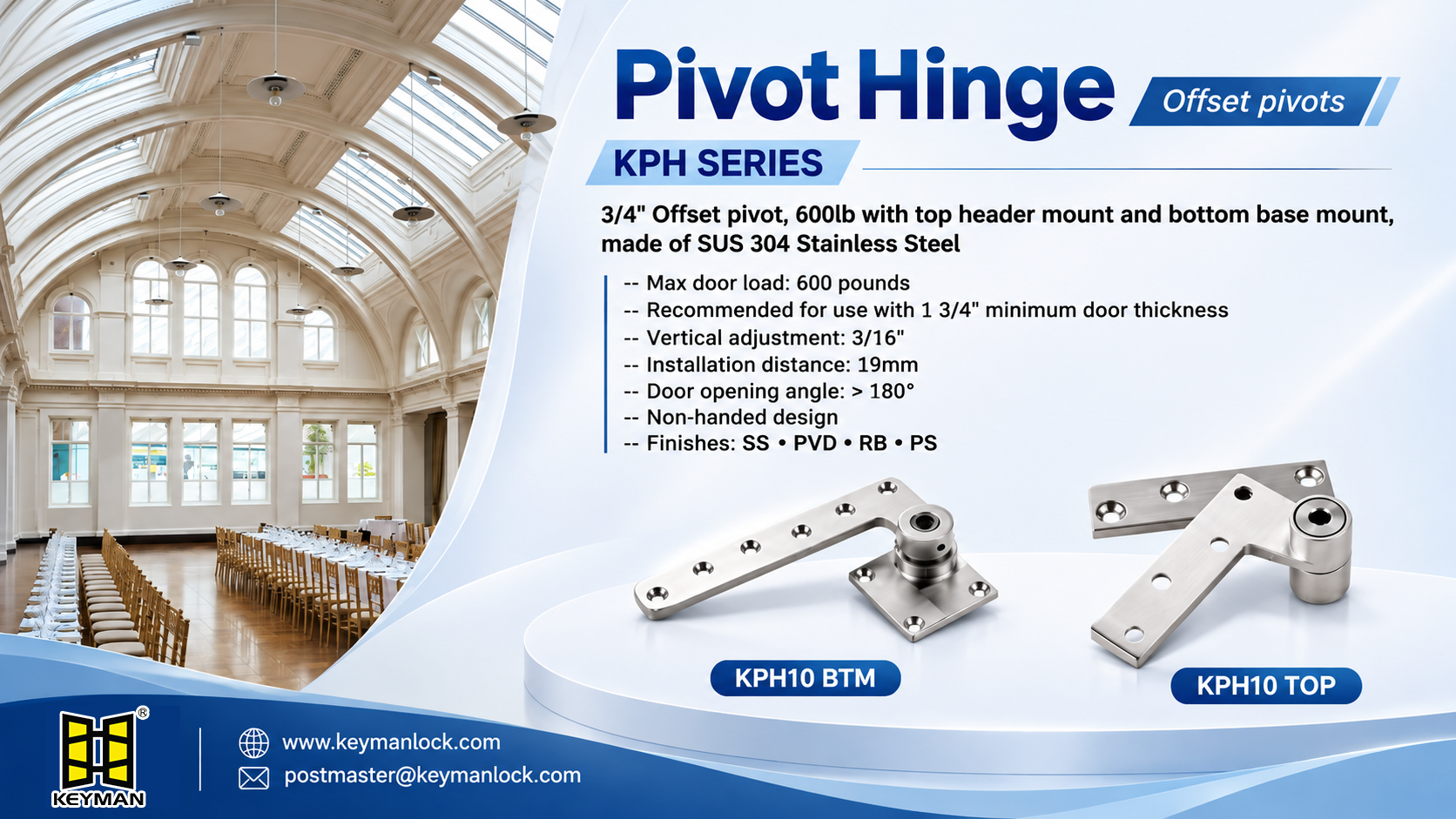
Zhongshan Keyman Locks Products Ltd., known commercially as Keyman Lock, manufactures heavy duty pivot hinges designed around this exact problem, pairing stainless steel (SUS 304) and cast steel construction with reinforced bearing structures built to carry substantial door weight through high-frequency use. Keyman Lock's 3/4-inch offset pivot sets are engineered to let doors clear substantial frames or obstructions while maintaining smooth, aligned operation, a detail that matters for oversized commercial and institutional doors where frame clearance and weight distribution both come into play.
For applications that also require integrated access control, Keyman Lock offers an electrified middle pivot hinge option, which routes wiring for electronic locks, alarms, or sensors directly through the hinge body instead of relying on exposed conduit. It's worth noting that this electrified pivot is designed for power transfer rather than structural load-bearing, so it's typically paired with a separate load-bearing pivot set to carry the door's actual weight. Choose the electrified option if your project needs concealed wiring for access control alongside a properly load-rated pivot hinge; choose a standard stainless steel or cast steel pivot set if weight-bearing capacity is your primary concern and no electrification is needed.
Getting the spec right the first time
Oversized and high-traffic doors put real, measurable demands on hardware, and guesswork is an expensive way to find out a pivot hinge was under-specified. Start with an accurate weight measurement, account for width-to-height proportions, factor in realistic daily cycle counts, and build in weight redundancy before locking in your hardware choice. From there, match those numbers to a pivot set with verified material construction and bearing quality, not just a "heavy duty" label.
If you're specifying hardware for a commercial, industrial, or institutional door project, reviewing a manufacturer's detailed load ratings and bearing specifications, like those published for Keyman Lock's heavy duty pivot hinges, is a reliable next step toward hardware that performs for the life of the door.
Frequently Asked Questions
How much weight can heavy duty pivot hinges support?
Heavy duty pivot hinges typically support anywhere from 150 lbs to over 500 lbs, depending on the material and bearing construction. Cast steel and reinforced stainless steel pivot sets generally handle the upper end of that range, making them suitable for oversized commercial and industrial doors.
What is the difference between a pivot hinge and a standard butt hinge?
A pivot hinge supports a door through a vertical axis point at the top and bottom of the door rather than along the side with hinge leaves. This design distributes weight more evenly, which makes pivot hinges better suited to heavier, wider, or more frequently used doors than standard butt hinges.
Do heavy duty pivot hinges work with electrified access control systems?
Yes. Some pivot hinges, including Keyman Lock's electrified middle pivot hinge, are designed to route wiring for electronic locks, sensors, or alarms directly through the hinge, eliminating the need for external conduit. These electrified units are generally non-load-bearing and are used alongside a separate structural pivot set.
How do I know if my door needs a 3/4-inch offset pivot set?
A 3/4-inch offset pivot set is typically required when a door needs extra clearance from a substantial frame or obstruction. If your door design includes deep frames, added trim, or specific clearance requirements from an architect's spec, confirm the offset measurement before ordering.
What material is best for a heavy duty pivot set in exterior applications?
Stainless steel, such as SUS 304, offers strong corrosion resistance and is well suited to exterior doors exposed to moisture and temperature changes. Cast steel is generally reserved for interior, high-weight applications where maximum load capacity is the priority over environmental resistance.


KEYMAN is Your Choice Of Security!
If you have any questions regarding our products or services, please leave your details and our team will respond to you.
: +86-13823964887
: +86-13823964887


