
When specifying architectural hardware for high-traffic commercial buildings, choosing the right pivot hinge is critical for long-term door performance, safety compliance, and lifecycle cost efficiency. Unlike traditional butt hinges that transfer door weight onto the side jamb screws, a commercial pivot set shifts the vertical load directly to the floor structure—making it the preferred solution for oversized, extra-heavy, and high-frequency doors.
However, architects, contractors, and hardware distributors frequently face a core specification decision: Offset pivot vs. center hung pivot.
While both systems use top and bottom pivot points, their pivot axis geometry, frame compatibility, swing direction, and fire-rating eligibility are fundamentally different. In this technical guide, the engineering team at Keyman Lock breaks down how each system works and how to select the right pivot door hinge for your next project.
Quick Comparison: Offset Pivot vs. Center Hung Pivot
For quick project specification, here is how the two pivot architectures compare across key engineering parameters:
Feature / Specification | Offset Pivot (e.g., 3/4" Offset) | Center Hung Pivot |
Pivot Axis Location | Set back from the door face (typically 3/4" or 1-1/2") | Directly in the center of the door thickness |
Swing Direction | Single-acting only (in-swing or out-swing) | Double-acting (swings both ways) or single-acting with door stop |
Frame Compatibility | Standard rabbeted hollow metal, aluminum, or wood frames | Non-rabbeted (cased opening) frames or frameless glass |
Fire Rating Eligibility | Yes (UL 10C / NFPA 80 compliant when tested) | No (Cannot seal tightly against smoke and fire stops) |
Intermediate Pivot Support | Compatible with matching intermediate pivots | Not compatible (cannot use side-mounted intermediate pivots) |
Weather & Acoustic Seal | High (closes tightly against frame stops and weatherstripping) | Low to Moderate (requires perimeter clearance gaps for swing) |
Typical Applications | Exterior entrances, fire doors, lead-lined hospital doors, heavy office doors | Interior restaurant doors, retail storefronts, vestibule doors, concealed doors |
What Is an Offset Pivot Hinge?
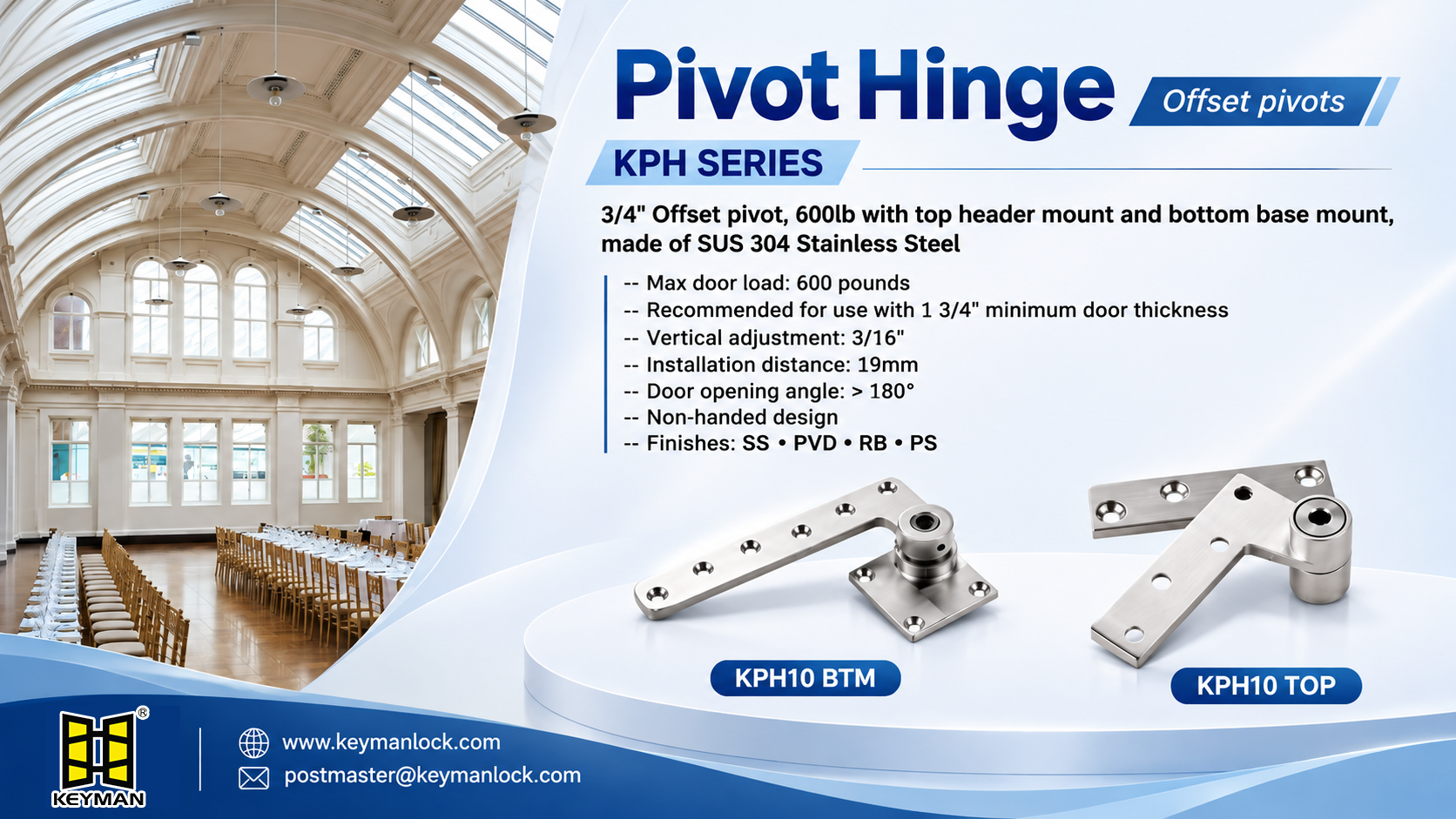
An offset pivot positions the vertical axis of rotation slightly outside the face of the door—most commonly at a 3/4-inch (19 mm) offset from the hinge edge of the door, though 1-1/2-inch offsets are also used for deeper reveals or thick wall cladding.
Because the pivot point sits outside the door plane, the door swings clear of the frame jamb when opened, creating an unobstructed opening width at 90 degrees.
Key Advantages of Offset Pivots
Superior Load Capacity for Heavy Doors: Engineered as heavy duty pivot hinges, offset pivot sets distribute substantial vertical weight into the bottom floor bearing while keeping lateral stress off the frame header.
Fire-Rated & Smoke-Control Compliant: Because an offset pivot works with standard rabbeted frames and door stops, the door closes flush against perimeter seals. This makes offset pivots mandatory when specifying pivot hardware for fire-rated openings.
Supports Tall Doors via Intermediate Pivots: For doors exceeding 60 to 90 inches in height—or heavy lead-lined radiation doors—an offset system allows you to install an intermediate pivot along the door edge to prevent warping and maintain vertical alignment.
Weather & Sound Isolation: Ideal for exterior commercial entrances where thermal seals, weatherstripping, and acoustic dampening are required.
Limitations of Offset Pivots
Visible Hardware: The knuckles of the top, bottom, and intermediate pivots remain visible on the pull side of the door.
Single-Acting Only: An offset pivot hinge can only swing in one direction (either inward or outward) due to the frame stop.
Engineering Tip: When specifying offset hardware for standard commercial metal or wood doors, explore our 3/4" Offset Pivots engineered for high-cycle commercial durability.
What Is a Center Hung Pivot Hinge?
A center hung pivot places the axis of rotation directly along the center line of the door's thickness (typically 1-3/4" or 2" thick doors). The top pivot is mortised into the top rail of the door and frame header, while the bottom pivot is mortised into the bottom rail and mounted to the floor (or coupled with a concealed floor spring).
Key Advantages of Center Hung Pivots
Double-Acting (Two-Way) Swing: Because the door rotates around its central axis, it can swing smoothly in both directions without hitting a frame stop—making it ideal for high-traffic restaurant kitchens, retail corridors, and hospital vestibules.
Clean, Concealed Aesthetics: When the door is closed, the pivot hardware is virtually invisible, delivering the minimalist, flush architectural look favored in modern commercial interiors and frameless glass storefronts.
Balanced Weight Distribution: The door's center of gravity sits directly over the bottom thrust bearing, reducing torsional twisting on the door leaf.
Limitations of Center Hung Pivots
Not Fire-Rated: Because center-hung doors require perimeter clearance gaps (radiused door edges) to swing freely without binding, they cannot form a tight smoke or fire seal. They are restricted to non-fire-rated openings.
No Intermediate Pivot Option: You cannot mount a side-jamb intermediate pivot on a center-hung door, which limits maximum door height compared to reinforced offset systems.
ANSI/BHMA Standards to Check Before Specifying Pivot Sets
Whether you are sourcing pivot hinges for doors in North America or specifying hardware for international commercial projects, verifying third-party ANSI/BHMA certification ensures the hardware can withstand real-world abuse:
ANSI/BHMA A156.4 (Door Controls – Closers & Pivots): Governs door closers and floor-mounted closing pivot systems. Look for an ANSI/BHMA 156.4 Grade 1 pivot hinge rating for high-traffic institutional and commercial buildings (tested to over 1,000,000+ operating cycles).
ANSI/BHMA A156.17 (Self-Closing Hinges & Pivots): Specifically covers architectural pivot sets and self-closing pivot hardware, defining strict benchmarks for vertical load capacity, lateral wear resistance, and corrosion protection.
How to Decide: 4 Practical Questions for Your Project
If you are still deciding between an offset or center hung pivot set, ask these four specification questions:
Is the door fire-rated or an exterior entrance?
Choose Offset Pivot. You need a rabbeted frame stop for fire compliance, weatherproofing, and security latching.
Does the door need to swing in both directions (double-acting)?
Choose Center Hung Pivot. Only a center-hung axis allows effortless two-way traffic flow.
Is the door extra tall (over 90 inches) or unusually heavy (e.g., X-ray lead-lined or solid core acoustic doors)?
Choose Offset Pivot + Intermediate Pivot. Combining a heavy-duty offset pivot set with one or more Intermediate Pivots prevents door sag and maintains precise latch alignment over decades of use.
Is concealed, minimalist architecture the top priority on an interior door?
Choose Center Hung Pivot. With both top and bottom hardware concealed inside the door rails, it offers the cleanest visual profile.
Partner with a Certified Commercial Pivot Hinge Manufcturer
Selecting the right pivot geometry is only half the equation—precision CNC machining, high-grade stainless steel or cast steel construction, and sealed thrust bearings determine whether a door operates smoothly after 500,000 cycles.
At Zhongshan Keyman Locks Products Ltd. (Keyman Lock), we manufacture heavy-duty architectural door hardware built to meet strict ANSI/BHMA Grade 1 performance standards. Whether your project requires standard 3/4" offset pivots, heavy-duty intermediate pivots, or customized OEM/ODM pivot sets in US32D, US26D, or architectural matte finishes, our engineering team is ready to support your specifications.
Contact Keyman Lock Engineering Team to request technical CAD drawings, load-capacity charts, or wholesale pricing for your upcoming project.


KEYMAN is Your Choice Of Security!
If you have any questions regarding our products or services, please leave your details and our team will respond to you.
: +86-13823964887
: +86-13823964887


