
An ANSI Grade 1 mortise lock is the highest-rated commercial door lock under the ANSI/BHMA A156.13 standard, built to withstand heavy daily use, forced entry attempts, and demanding fire-safety requirements. It's the go-to choice for high-traffic commercial buildings like offices, schools, and hospitals that need durable, code-compliant hardware on every door.
Below, we break down what makes this lock type unique, the standards it must meet, and the practical benefits it offers building owners and facility managers.
What Is a Mortise Lock?
A mortise lock is a lock housed in a pocket ("mortise") cut into the edge of a door, rather than mounted through a drilled hole like a cylindrical lock. This design allows the lock body to hold multiple functions—latch, deadbolt, and sometimes an anti-friction latch—inside a single reinforced case.
Because the mechanism sits inside the door itself, mortise locks generally offer stronger resistance to prying and impact than surface-mounted alternatives. This structural advantage is a major reason mortise locks are the preferred hardware type for commercial mortise lock applications, especially in doors that see constant use throughout the day.

What Does "ANSI Grade 1" Mean?
ANSI Grade 1 is the top-performance tier defined by the American National Standards Institute (ANSI) and the Builders Hardware Manufacturers Association (BHMA) under the ANSI/BHMA A156.13 Standard for Mortise Locks & Latches. It certifies that a lock has passed rigorous cycle, strength, and security testing beyond what Grade 2 or Grade 3 hardware requires.
In practical terms, Grade 1 certification means the lock has been tested for:
Cycle durability – typically rated for hundreds of thousands of open/close cycles
Strength testing – resistance to force applied to the latch, deadbolt, and lever
Security performance – resistance to common attack methods like drilling and prying
This makes an ANSI Grade 1 mortise lock the standard specification for commercial and institutional buildings where doors are used dozens or hundreds of times a day.
Key Features of an ANSI Grade 1 Mortise Lock
A heavy-duty mortise lock built to Grade 1 standards typically includes:
Reinforced lock case – a solid metal body designed to resist prying and impact
Multi-function capability – supports latch, deadbolt, and auxiliary latch functions in one unit
High-cycle mechanisms – internal components engineered for extended daily use without failure
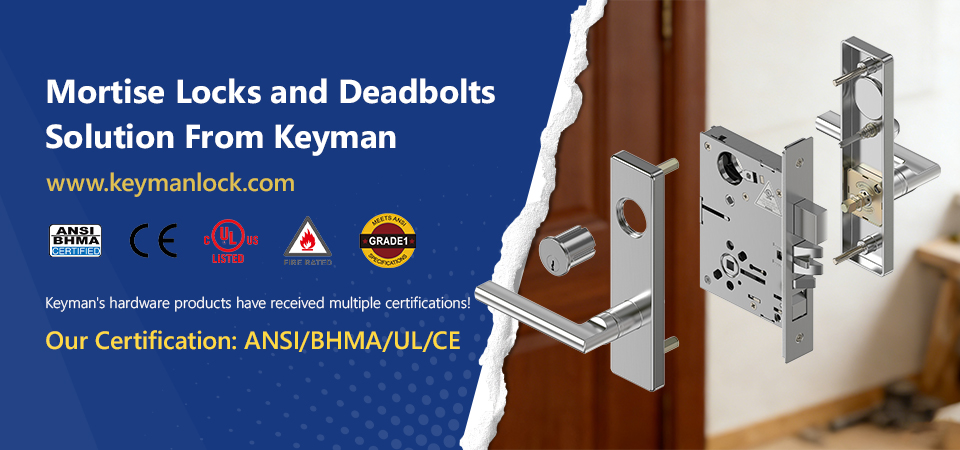
Fire-rated construction – many models, such as Keyman's M7 Series, are rated under ANSI/UL 10C and CAN/ULC-S104 for up to 3-hour fire resistance
Compatibility with various trim and cylinder options – allowing flexibility across different door and access-control setups
These features work together to deliver hardware that holds up under constant mechanical stress while still meeting building and fire code requirements.
What Standards Apply to ANSI Grade 1 Mortise Locks?
Beyond the core ANSI/BHMA A156.13 grading standard, ANSI mortise locks intended for commercial or fire-rated openings must often satisfy additional certifications, including:
ANSI/UL 10C & CAN/ULC-S104 – fire door assembly testing, often certifying up to 3-hour fire ratings
UL Listing – third-party verification that the lock meets safety and performance benchmarks
Local and national building codes – which frequently require Grade 1-rated hardware on doors in high-occupancy or life-safety-critical areas
Specifying hardware that meets these combined standards helps ensure a building passes inspection and remains compliant over the life of the door.
What Are the Benefits of Using an ANSI Grade 1 Mortise Lock?
Facility managers and architects specify Grade 1 mortise locks for several practical reasons:
Long service life – built to withstand hundreds of thousands of cycles, reducing replacement and maintenance costs
Stronger security – reinforced construction resists common forced-entry tactics better than lower-grade hardware
Fire code compliance – fire-rated models allow the lock to be installed on rated door assemblies without compromising safety certification
Consistent performance in high-traffic settings – ideal for entrances, stairwells, and corridors that see continuous use throughout the day
Design flexibility – multi-function capability means fewer separate hardware components to install and maintain
Where Are ANSI Grade 1 Mortise Locks Typically Used?
ANSI Grade 1 mortise locks are most common in commercial and institutional settings where durability and security are non-negotiable, including:
Office buildings and corporate campuses
Schools and universities
Hospitals and healthcare facilities
Government buildings
Multi-family residential entrances
If you're specifying hardware for one of these settings, explore Keyman's ANSI Grade 1 mortise lock product line for models like the M7 Series, which combines ANSI/BHMA A156.13 grading with UL fire-rated performance.

Frequently Asked Questions
What's the difference between ANSI Grade 1, Grade 2, and Grade 3 mortise locks?
Grade 1 offers the highest cycle durability and security performance, making it suitable for commercial and high-traffic applications. Grade 2 is a mid-tier option often used in light commercial settings, while Grade 3 is generally reserved for residential use.
Can an ANSI Grade 1 mortise lock be used on a fire-rated door?
Yes, provided the specific model is also certified under standards like ANSI/UL 10C and CAN/ULC-S104. Not all Grade 1 locks carry a fire rating, so it's important to confirm this certification before installation on a rated door assembly.
How long does an ANSI Grade 1 mortise lock typically last?
Because Grade 1 hardware is tested for hundreds of thousands of cycles, these locks are designed to perform reliably for many years, even under continuous daily use in commercial settings.
Do ANSI Grade 1 mortise locks require special installation?
Mortise locks require a pocket cut into the door edge, which typically calls for professional installation to ensure proper fit and function, especially when paired with fire-rated door assemblies.
For more on hardware certifications, see our certifications overview, or learn more about choosing the right mortise lock for commercial buildings.


KEYMAN is Your Choice Of Security!
If you have any questions regarding our products or services, please leave your details and our team will respond to you.
: +86-13823964887
: +86-13823964887


