
Quick answer:
A UL Listed flush bolt is a door hardware component tested and certified by Underwriters Laboratories to maintain its locking function during a fire for a specified duration, typically up to 1.5 hours. UL fire door flush bolts are required on pairs of fire-rated doors to keep the inactive leaf secured, preventing fire and smoke from spreading through gaps in the doorway.
Fire doors only work as intended when every component installed on them meets the same safety standard. A door slab might carry an impressive fire rating, but if the hardware holding it shut fails under heat, the entire assembly loses its protective value. This is where the UL Listed flush bolt becomes essential.
Flush bolts are the hardware devices installed on the inactive leaf of a pair of doors, securing it into the frame so the active leaf can latch properly against it. On fire-rated door assemblies, these bolts can't just be functional, they have to be certified to perform under fire conditions. That certification comes from Underwriters Laboratories (UL), an independent safety science company that tests building products against strict performance benchmarks.
This post breaks down what a UL Listed flush bolt actually is, how it differs from a standard flush bolt, and why specifying the right UL fire door flush bolt matters for architects, contractors, and facility managers responsible for code compliance.
What does "UL Listed" mean for a flush bolt?
A UL Listed flush bolt has undergone fire and cycle testing by Underwriters Laboratories and met the requirements to carry a UL fire rating. UL testing evaluates how the hardware performs under sustained high heat, confirming that the bolt continues to hold the door closed instead of warping, melting, or releasing prematurely.
For manufacturers, earning this listing isn't optional if the product is intended for fire-rated openings. Building codes and standards organizations, including NFPA 80 (Standard for Fire Doors and Other Opening Protectives), reference UL listings as the benchmark for acceptable fire door hardware. Specifiers and inspectors look for the UL mark as proof that a product has been independently verified, not just claimed by the manufacturer.
How is a UL fire door flush bolt different from a standard flush bolt?
A standard flush bolt is designed purely for mechanical function, securing an inactive door leaf for everyday use. A UL fire door flush bolt has to do that same job while also surviving fire exposure testing. The materials, construction, and automatic engagement mechanism are all evaluated as part of the listing process.
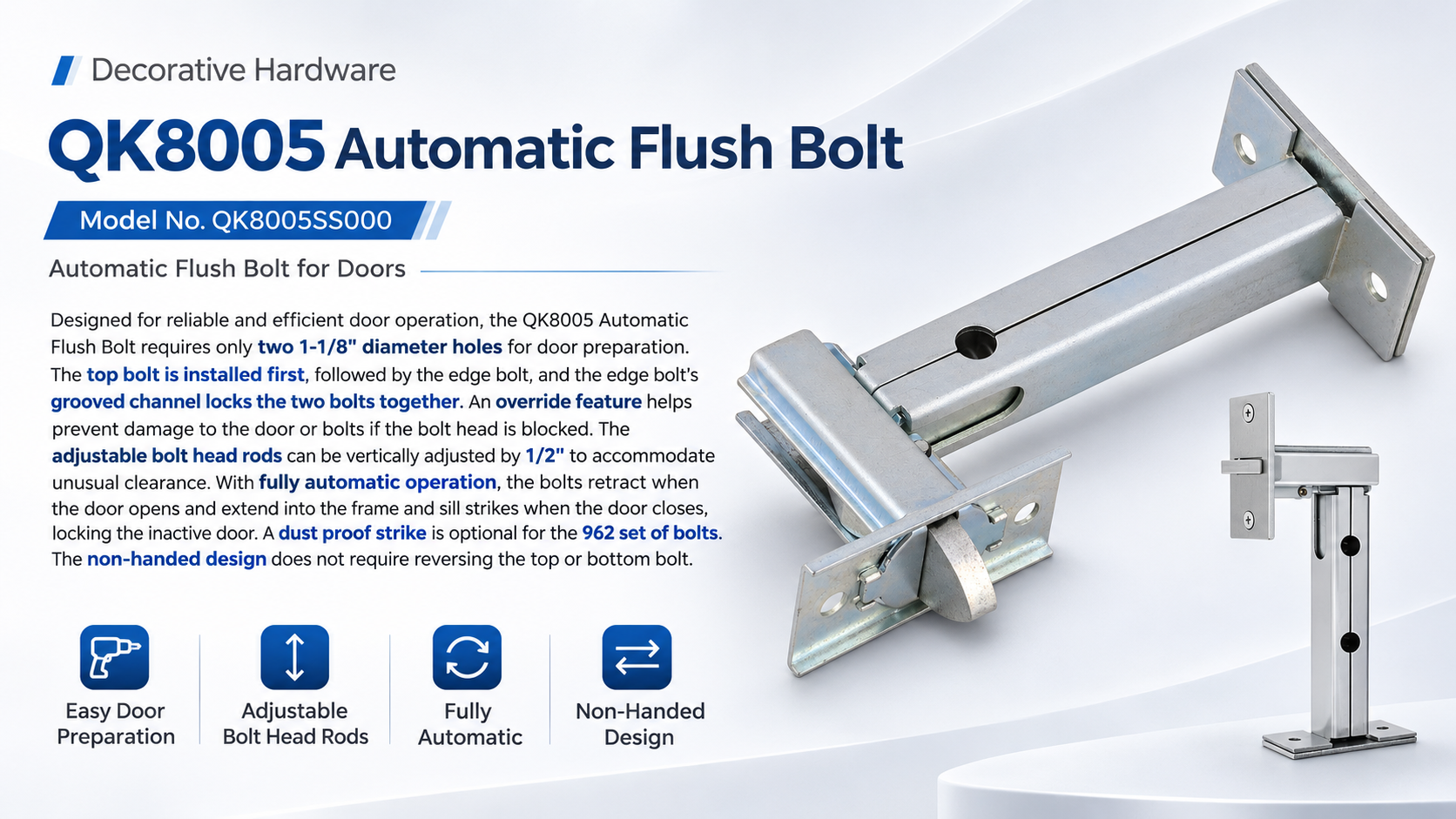
Automatic flush bolts, like the KEYMAN Auto Flush Bolt from Zhongshan Keyman Locks Products Ltd. (Keyman Lock), illustrate this distinction well. The KEYMAN Auto Flush Bolt carries a 1.5-hour fire rating and is rated for a million operating cycles, making it suitable for high-traffic commercial doors where reliability under repeated use matters as much as fire performance. Because it's automatic, the bolt engages when the door closes and releases when the door opens, removing the need for anyone to manually throw the bolt each time. That automation reduces the chance of human error, a door left unsecured because someone forgot to engage the bolt manually is a real risk in busy commercial buildings.
Why is a UL Listed flush bolt important for fire doors?
Fire doors are only as effective as their weakest component. A pair of fire-rated doors relies on the inactive leaf staying firmly secured so the active leaf can latch into it and close the gap completely. If the flush bolt fails during a fire, even a code-compliant door assembly can allow flames and smoke to pass through.
Choose a UL Listed flush bolt if the opening is part of a fire-rated wall assembly or if local code requires certified hardware on fire-rated pairs, which is the case in most commercial, institutional, and multi-family buildings. For non-rated interior doors where fire separation isn't a concern, a standard flush bolt may be sufficient and more cost-effective.
What role does automatic operation play in fire door performance?
Automatic flush bolts like the KEYMAN model engage without the user having to flip a lever or push a bolt into place. This matters in buildings with heavy foot traffic, where manual bolts are more likely to be left disengaged simply because staff or visitors forget. An automatic mechanism removes that point of failure, helping ensure the inactive leaf is secured every time the door closes, not just when someone remembers to lock it.
What installation features should a UL fire door flush bolt have?
A well-designed UL fire door flush bolt should offer a non-handed design, meaning it can be installed at the top or bottom of the door without needing a left- or right-specific version. This simplifies inventory for distributors and installation for contractors. Vertical adjustment, such as the 1/2-inch range built into the KEYMAN Auto Flush Bolt, also matters because it allows installers to fine-tune alignment with the strike plate in the frame or floor, ensuring consistent engagement over the life of the door.
Who needs to specify UL Listed flush bolts?
Architects and door hardware consultants are typically the ones specifying flush bolts during the design phase of a commercial building, but the responsibility to verify compliance extends further down the chain:
Architects and specifiers need to confirm that any flush bolt called out in a door hardware schedule carries the correct UL fire rating for the opening's required duration (typically 20, 45, 60, or 90 minutes, up to 1.5 hours for higher-rated assemblies).
General contractors and door installers are responsible for installing the exact hardware specified, not a substitute, since swapping in a non-rated bolt can invalidate the fire door's listing.
Facility managers and building owners need to maintain and periodically test fire door hardware, including flush bolts, to ensure it continues to function correctly, since NFPA 80 requires annual fire door inspections in most commercial occupancies.
Distributors and hardware suppliers play a role too, sourcing from manufacturers who can provide UL documentation and certificates of compliance alongside the physical product.
What happens if a non-rated flush bolt is installed on a fire door?
Installing a non-rated flush bolt on a fire-rated door assembly voids the fire rating of that opening, regardless of how the door itself is rated. During an inspection, this discrepancy is typically flagged as a code violation, requiring the building owner to replace the hardware before the opening can be certified as compliant. Beyond the compliance issue, a non-rated bolt may not hold under fire conditions, undermining the safety function the door was installed to provide in the first place.
Choosing the right flush bolt for your fire door project
Selecting hardware for fire-rated openings isn't a place to cut corners or assume one product fits every application. A UL Listed flush bolt, verified against the specific fire rating required for the opening, is a non-negotiable component of a compliant fire door assembly. For high-traffic commercial doors, an automatic option like the KEYMAN Auto Flush Bolt offers the added benefit of consistent engagement without relying on manual operation, backed by a 1.5-hour fire rating and a million-cycle durability rating.
Before finalizing a door hardware schedule, confirm that every flush bolt, hinge, and exit device on the opening carries documentation matching the required fire rating. When in doubt, consult with your hardware supplier or manufacturer, such as Keyman Lock, to review product certificates and ensure every component on the door meets the standard the building code demands.
Frequently Asked Questions
What fire rating does a UL Listed flush bolt need to have?
The required fire rating depends on the opening's classification in the building's fire separation plan, commonly 20, 45, 60, 90 minutes, or up to 1.5 hours for certain assemblies. The flush bolt's UL rating should match or exceed the rating required for that specific opening.
How much does a UL fire door flush bolt cost compared to a standard flush bolt?
UL Listed flush bolts typically cost more than non-rated alternatives due to the additional materials, testing, and certification involved. Exact pricing varies by manufacturer, finish, and whether the bolt is manual or automatic.
Can a manual flush bolt be UL Listed?
Yes. Both manual and automatic flush bolts can carry a UL fire rating, provided they've passed the required testing. Automatic models simply add the benefit of engaging without user action, which can reduce the risk of the bolt being left disengaged.
Are UL Listed flush bolts required by law?
Requirements come from the building codes adopted in a given jurisdiction, which typically reference standards like NFPA 80. In most cases, any door that's part of a required fire-rated assembly must use hardware, including flush bolts, that carries the matching UL listing.
What's the difference between a top rod and bottom rod on an automatic flush bolt?
The top rod engages into the head frame of the doorway, while the bottom rod engages into the floor or threshold. Many automatic flush bolts, including non-handed designs, can be installed using either configuration depending on the opening's structure.


KEYMAN is Your Choice Of Security!
If you have any questions regarding our products or services, please leave your details and our team will respond to you.
: +86-13823964887
: +86-13823964887


