
A deadbolt is a standalone, single-bolt lock installed in a drilled hole, making it ideal for residential entry doors, while a mortise lock is a multi-function unit embedded into a pocket cut into the door, offering integrated latch and deadbolt mechanisms suited for commercial-grade security. Choosing between a deadbolt and a mortise lock ultimately comes down to the level of security, durability, and functionality your door and application demand. This guide breaks down the structural, security, and installation differences between deadbolt and mortise locks, so you can decide which option fits your home, business, or institutional project.
What Is the Structural Difference Between a Deadbolt and a Mortise Lock?
A deadbolt is installed as a separate unit through a drilled hole in the door, while a mortise lock requires a larger rectangular pocket (or "mortise") cut directly into the door's edge to house the entire lock body.
Deadbolt Installation
Requires two holes: one through the face of the door, one through the edge for the bolt.
Operates independently of the door's handle or latch set.
Minimal impact on the structural integrity of the door.
Mortise Lock Installation
Requires a deep pocket cut into the door, which can weaken the door's structural integrity if not reinforced properly.
Houses the latch, deadbolt, and sometimes additional functions within a single lock body.
Typically paired with a mortise lock cylinder and trim for a complete, integrated hardware system.
Because the mortise pocket removes more material from the door, mortise locks are generally installed in solid-core or metal commercial doors that can accommodate the larger cavity without compromising strength.
Is a Mortise Lock More Secure Than a Deadbolt?
In most commercial and high-security applications, a mortise lock is considered more secure than a standard deadbolt because it integrates multiple locking mechanisms—such as a latch and deadbolt—into one unified system, rather than relying on a single bolt.
Deadbolt Security Profile
Offers one bolt that extends into the door frame.
Security strength depends heavily on bolt throw length (ideally 1 inch or more) and strike plate reinforcement.
Vulnerable to forced entry if the door frame or strike plate isn't reinforced with long screws.
Mortise Lock Security Profile
Combines a spring latch and deadbolt (or deadlatch) in a single lock body, often operated by one key cylinder.
Many commercial mortise locks meet ANSI/BHMA Grade 1 standards, the highest security and durability rating for door hardware.
Integrated design makes the lock more resistant to prying, drilling, and forced entry attempts compared to a standalone deadbolt.
For commercial deadbolt vs mortise lock security comparisons specifically, mortise locks consistently outperform standard deadbolts in cycle testing, resistance to physical attack, and overall durability—making them the preferred choice for doors that see heavy daily traffic.
When Should You Use a Deadbolt vs. a Mortise Lock?
Deadbolts are best suited for residential entry doors where simplicity, cost-efficiency, and moderate security are priorities, while mortise locks are the standard for commercial main entrances, schools, hospitals, and other high-traffic or high-security environments.
Deadbolt — Best For:
Single-family homes and apartment entry doors
Secondary or interior doors needing added security
Budget-conscious residential projects
Doors where simple re-keying and maintenance are priorities
Mortise Lock — Best For:
Commercial main entrances and high-traffic doors
Schools, hospitals, and government buildings requiring Grade 1 hardware
Doors needing integrated latch and deadbolt function in one unit
Applications requiring ADA-compliant lever handles alongside secure locking
Why Is ANSI Grade 1 Mortise Lock the Standard for Commercial Projects?
ANSI Grade 1 mortise locks are the standard for commercial buildings because they meet the highest industry benchmarks for durability, cycle testing, and forced-entry resistance, ensuring reliable performance in high-traffic, high-security environments.
According to ANSI/BHMA A156.13 standards, Grade 1 locks must withstand significantly more operational cycles and higher force resistance tests than Grade 2 or Grade 3 hardware. This makes Grade 1 mortise locks the go-to choice for:
Durability under heavy use: Commercial doors can be opened hundreds of times daily; Grade 1 mortise locks are built to withstand this wear.
Code compliance: Many commercial building codes and insurance requirements specify Grade 1 hardware for main entrances and fire-rated doors.
Integrated functionality: A single Grade 1 mortise lock can combine latch, deadbolt, and exit function, reducing the number of separate hardware components needed on a door.
Long-term cost efficiency: While the upfront cost is higher than a standard deadbolt, the extended lifespan and reduced maintenance of Grade 1 hardware typically lowers total cost of ownership over time.
For businesses weighing a commercial deadbolt vs mortise lock decision, the added durability and integrated security of a Grade 1 mortise lock generally justifies the investment for doors that serve as primary access points.
Deadbolt vs. Mortise Lock: Quick Comparison
Feature | Deadbolt | Mortise Lock |
|---|---|---|
Installation | Drilled holes, standalone unit | Pocket cut into door edge |
Structural impact | Minimal | Moderate to significant without reinforcement |
Security level | Good for residential use | High; ANSI Grade 1 options available |
Functionality | Single bolt only | Integrated latch + deadbolt (and more) |
Typical use case | Homes, interior doors | Commercial entrances, schools, hospitals |
Maintenance | Simple, easy to re-key | More complex, often serviced by professionals |
Cost | Lower upfront cost | Higher upfront cost, better long-term durability |
Frequently Asked Questions
Can a mortise lock be installed on a residential door?
Yes, mortise locks can be installed on residential doors, particularly solid wood or reinforced doors, but they require professional installation due to the precision needed to cut the mortise pocket without weakening the door.
Does a mortise lock require a thicker door than a deadbolt?
Generally yes—mortise locks typically require a door thickness of at least 1¾ inches to safely accommodate the lock body, while deadbolts can be installed on thinner doors without structural concerns.
Are mortise locks more expensive to repair than deadbolts?
Mortise locks usually cost more to repair or replace because of their integrated components and the specialized tools or expertise required, whereas deadbolts are simpler and generally more affordable to service.
Can I upgrade from a deadbolt to a mortise lock on an existing door?
It's possible, but it typically requires professional door modification to cut the mortise pocket, and in some cases a full door replacement may be more cost-effective depending on the door's material and condition.
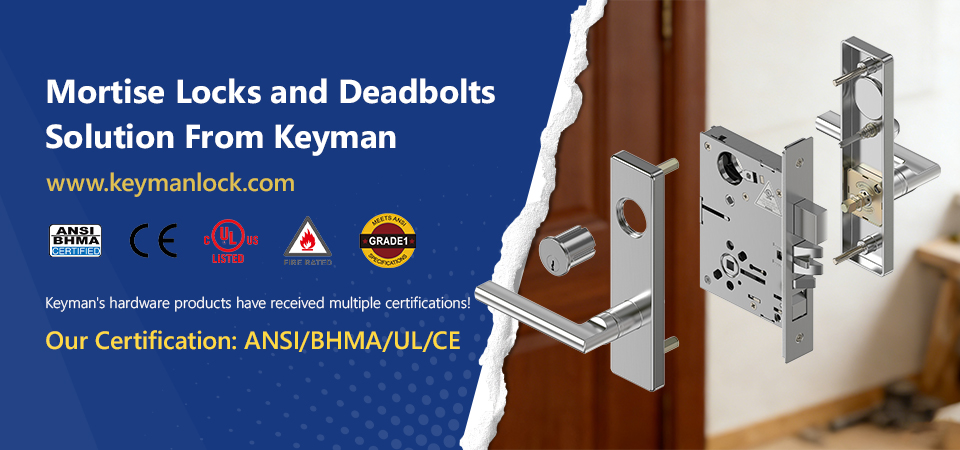


KEYMAN is Your Choice Of Security!
If you have any questions regarding our products or services, please leave your details and our team will respond to you.
: +86-13823964887
: +86-13823964887


